It’s no secret that conversational search tools and AI-generative answers have greatly changed the way people discover brands and make buying decisions. But how do you actually know what AI is saying about your brand or business in those environments? That’s something that traditional SEO really can’t answer, and impressions or page rankings don’t provide a clear enough picture, either.
Addressing that gap, Hall AI is a generative engine optimization (GEO) and AI visibility tool that tracks how content, websites, and brands appear in mentions and citations within AI-powered search environments.
Essentially, it’s an analytics platform for the AI layer of search. This makes Hall especially useful for marketers, content creators, and SEO professionals who need visibility into how AI systems surface and cite brands.
Hall AI At A Glance:
| Considerations | Hall AI |
| What It Does | Provides insights into brand visibility and citations across multiple AI-powered search engines, focusing on question-level reporting and answer analysis. |
| Biggest Strengths | Visibility analytics, cross-platform coverage, tracking of real AI queries, search demand data, and a free access tier for testing fit before committing or upgrading. |
| Biggest Limitations | Supported platforms at lower tiers only include ChatGPT, Perplexity, and Google AIO; a steep jump between the free plan and first paid plan. |
| Best For | Business or brand marketing teams. |
| Pricing (monthly) | Lite (free), Starter ($199/mo), Business ($599/mo), Enterprise ($1,499+/mo) |
I’ll take you on a tour of what Hall AI offers, along with its strengths, limitations, and real-world use cases.
What Is Hall AI?
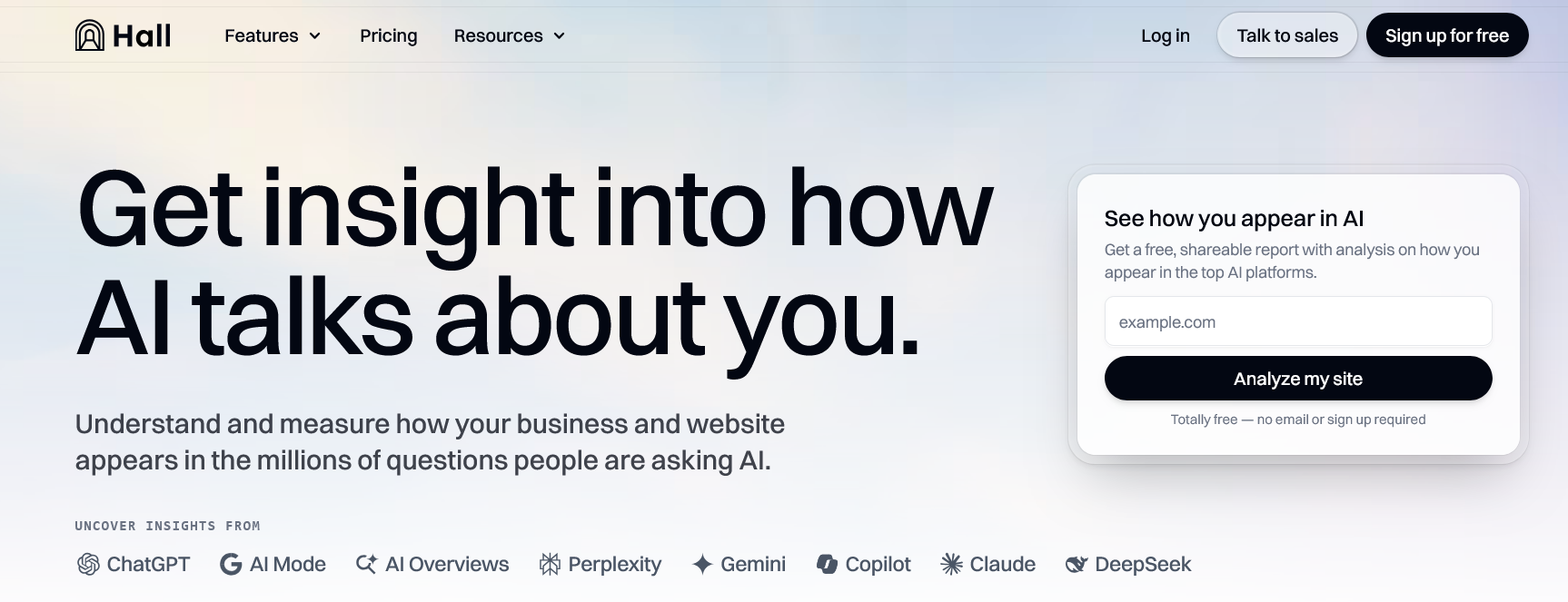
Hall AI is an analytics platform that provides insight into your brand’s visibility within AI-powered search environments, including where it’s being cited, how it’s being presented, and where it’s appearing (or isn’t) in relation to your competitors.
For anyone who needs to measure, analyze, and optimize visibility in spaces like ChatGPT, Google AI Overviews (AIO), Perplexity, and Claude (among others), Hall is a valuable tool that helps you understand exactly how AI treats your brand or related content when answering user queries.
And that, in turn, helps you make the best strategic decisions possible to improve your presence and relevance within AI answer environments.
Hall AI’s Best Features
There are several strong reasons to use Hall AI, but I’ll cover the most important features here, as well as why I think they’re valuable.
Generative Answer Visibility Insights
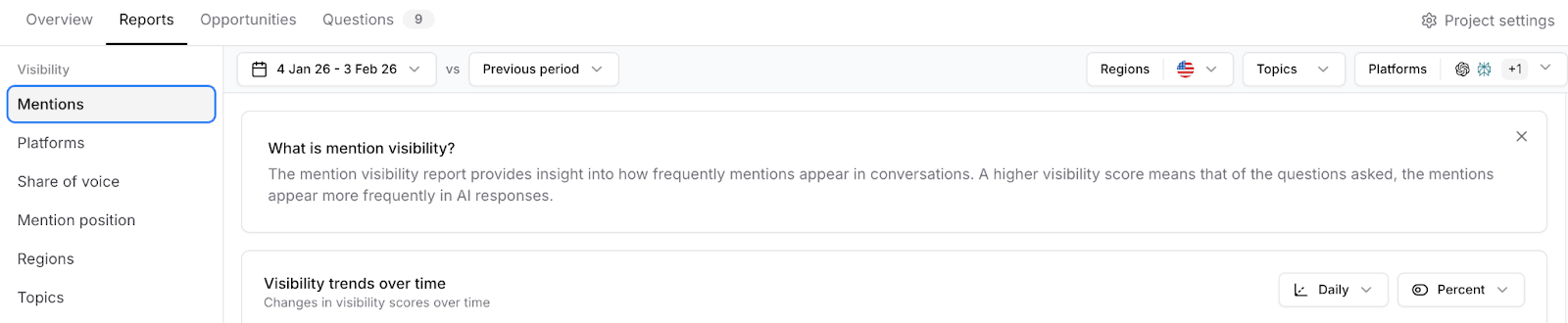
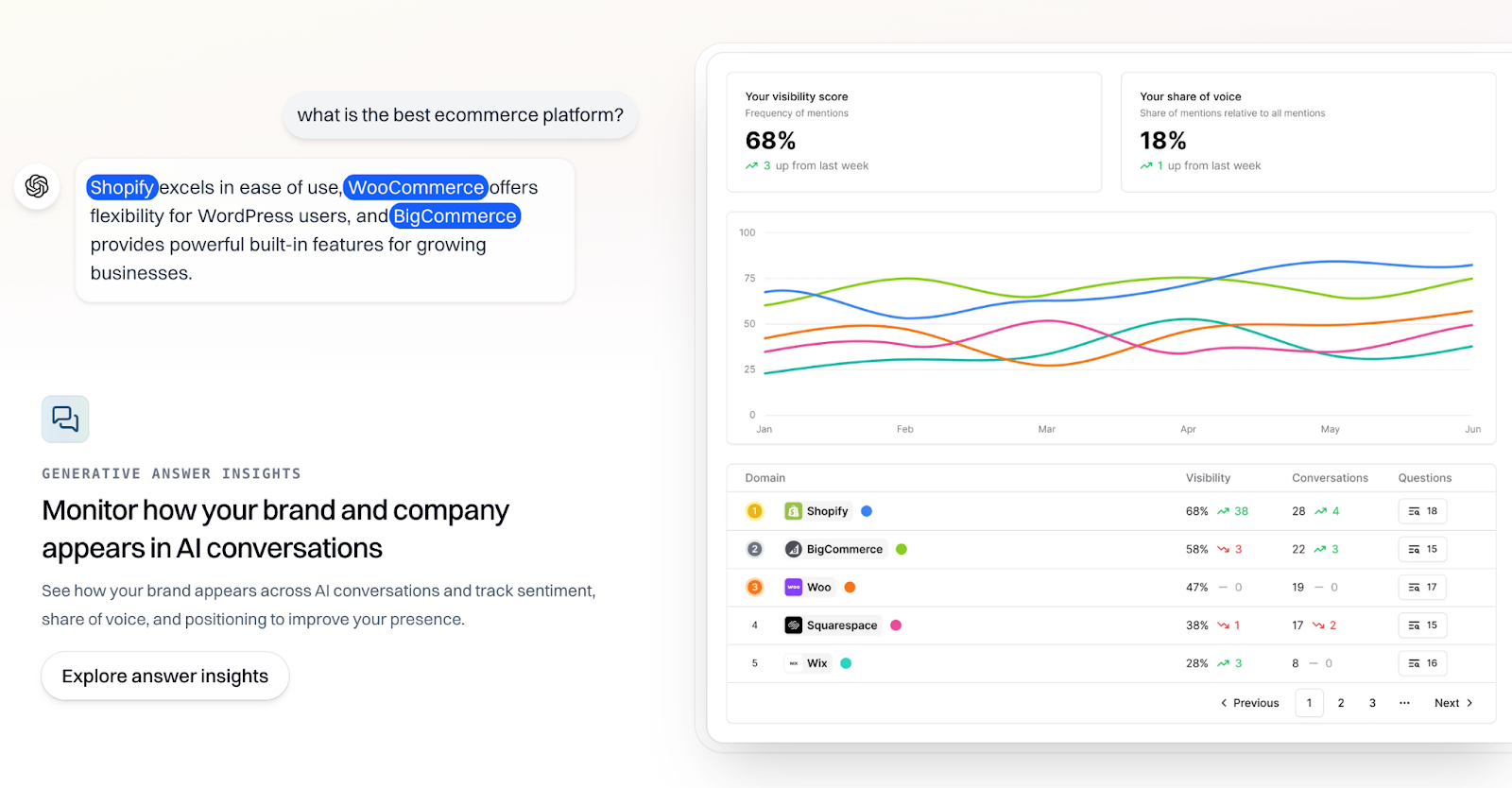
Visibility reports from Hall provide insights across several different aspects, including mentions, platforms, share of voice, position, regions, and topics.
The reporting allows users to filter results to focus solely on competitors if desired, while still providing vital insights into visibility trends, such as which brands or individuals are earning the most visible mentions and their relative share of mention frequency across answers.
Hall is particularly interested in the topic of visibility, as it reveals how frequently brands are mentioned in answers grouped by the project’s topics. This insight alone helps identify potential opportunities as a content creator.
Deep Citation Reporting
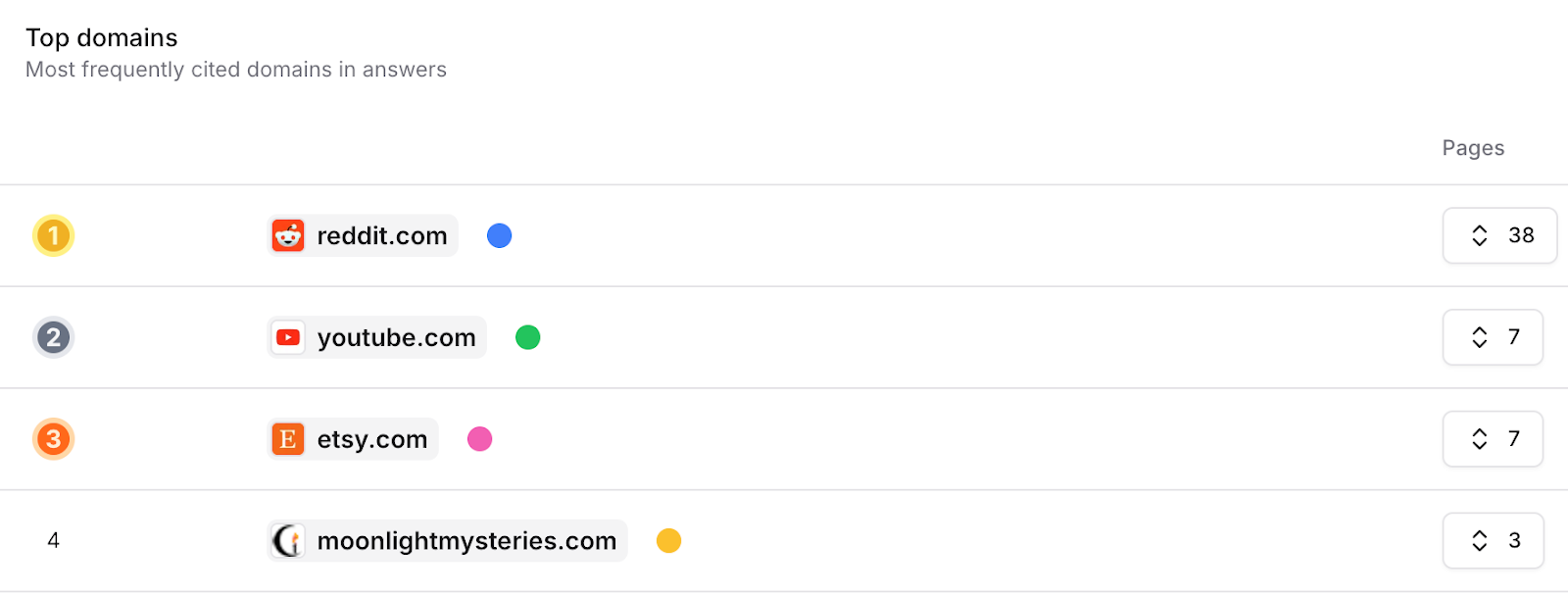
Hall AI has an entire reporting section dedicated to citations, which lets you explore the top domains, top pages, page categories, and even domain categories to help you reverse-engineer your strategy to improve your own citation frequency.
In my case, top domains were Reddit, YouTube, and Etsy (which was unsurprising), but the insights into page categories were especially insightful because they showed me the types of pages earning the most visibility for my particular project.
Especially if you’re in the process of building out content, this can be really useful visibility data to reference.
Question-Level Answer Analysis
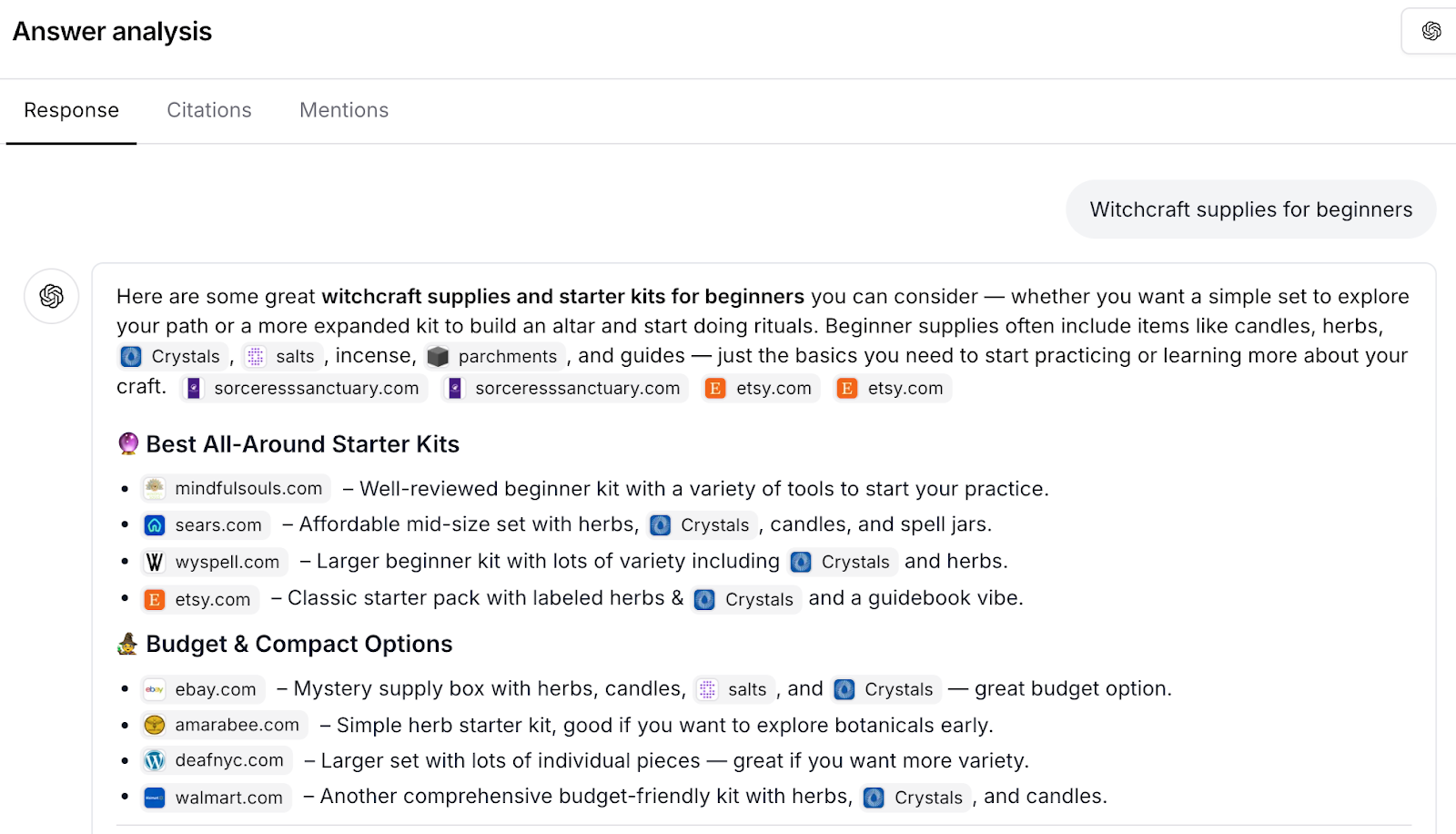
With Hall, you can build a curated set of questions (“queries”) tailored to your brand, making it easy to track where, and how often, you appear in AI-generated answers. Queries can be added manually, imported via .csv, or generated automatically using the built-in keyword tool if you’re not sure where to start.
The answer analysis view surfaces the exact outputs from ChatGPT, Perplexity, and Google’s AI Overviews, allowing you to compare results side by side. You can also review associated citations and brand mentions to better understand your visibility across each platform.
Search Demand Data
If you’re at all familiar with an SEO platform like Ahrefs or the like, you already know what search volume is. Hall offers something similar, specifically for AI answer engines.
The search demand report gives you insight into the number of times people are asking questions about topics in your project. If you’re in the process of creating new content specifically to grow your visibility, this is possibly the most valuable tool of all.
Search demand breaks this data down by topic, AI platform, demographics (age group, gender), and even region.
AI Site Analytics
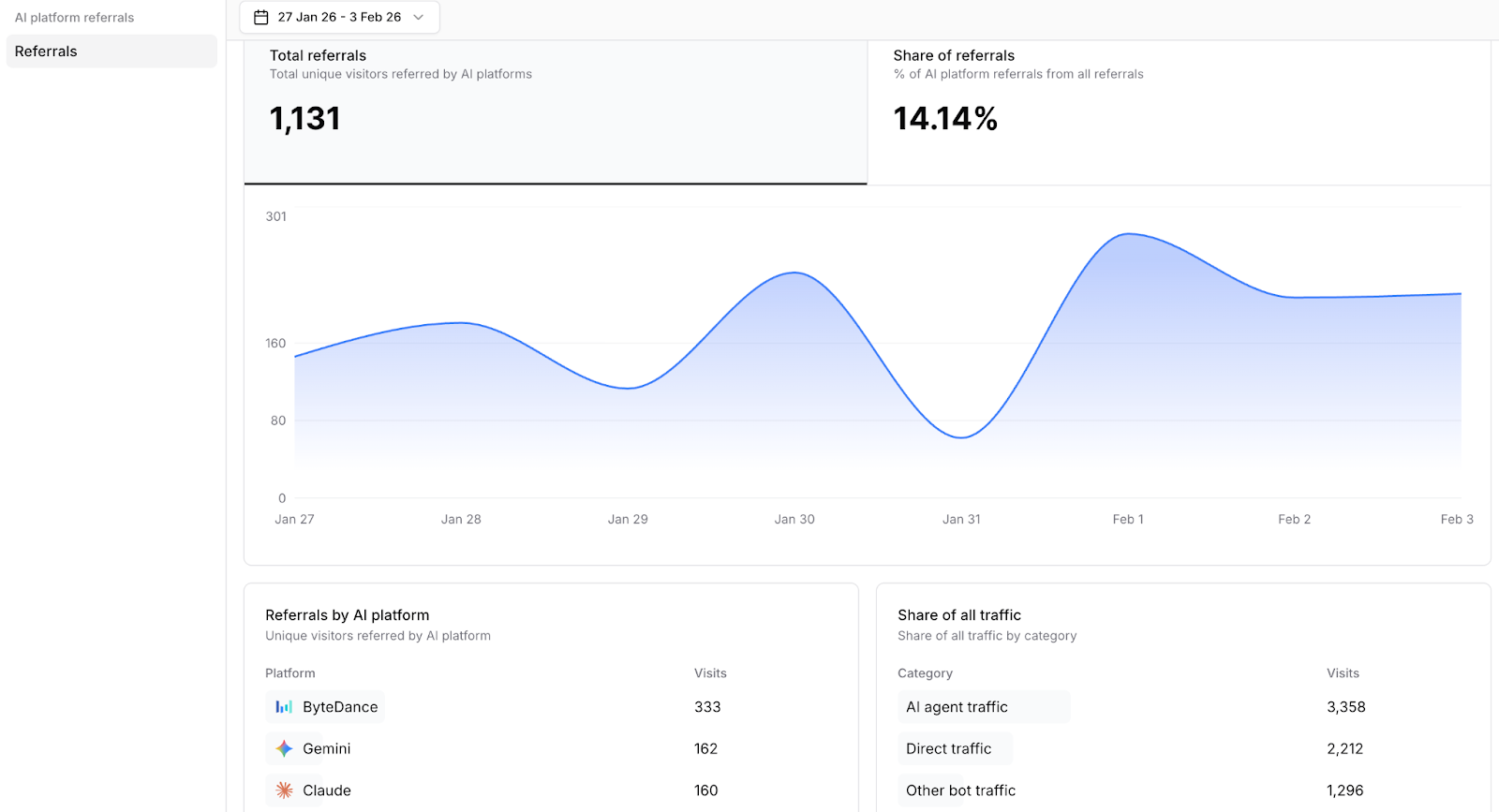
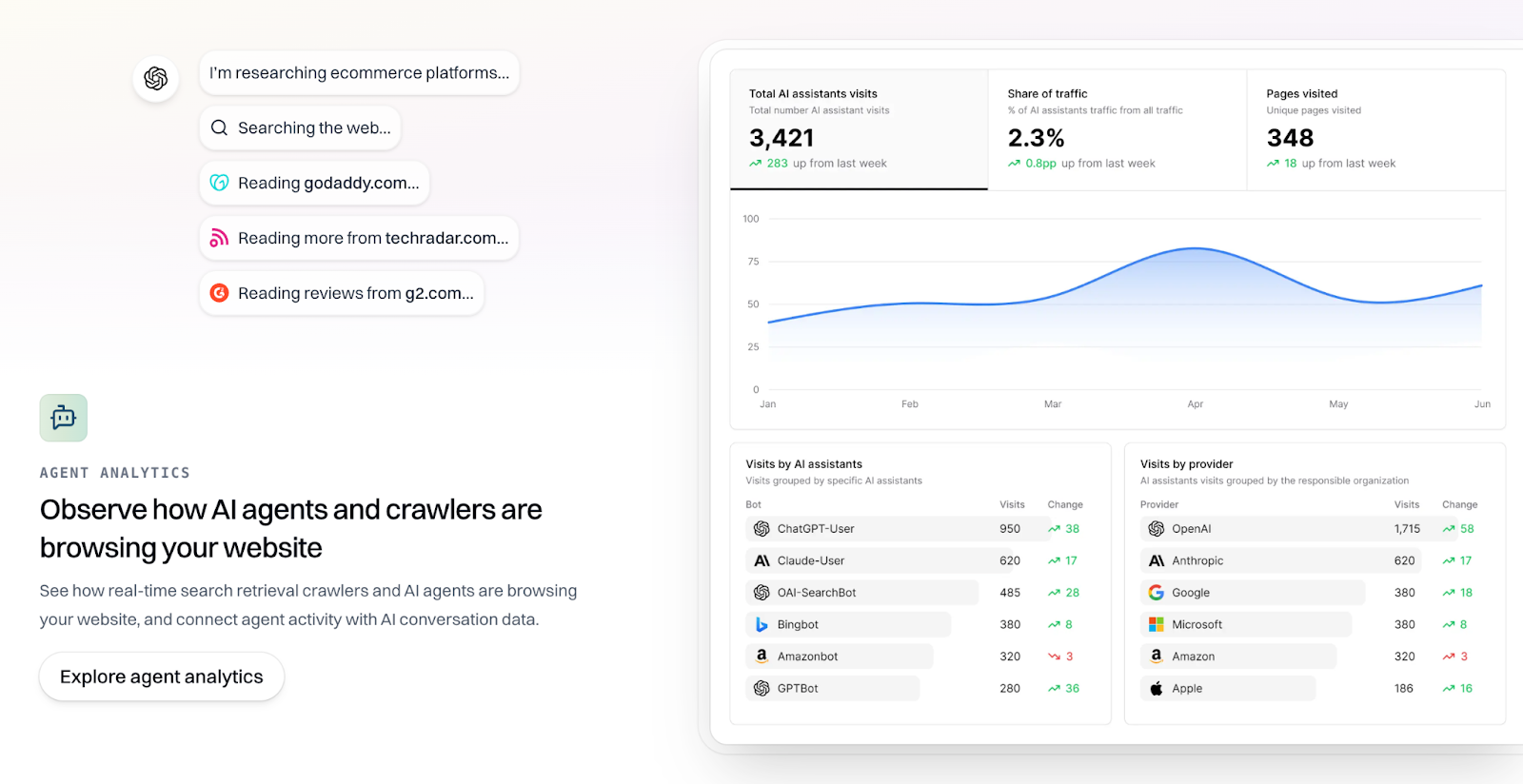
To understand how AI systems interact with your brand’s website, uncover potential visibility gaps, and optimize performance using real traffic data, you can enable analytics within Hall to track referrals and agent activity.
This makes it possible to attribute site traffic to the specific questions being asked across platforms like ChatGPT, Perplexity, and Google’s AI Overviews. While setup does require an API key, referral and agent-level tracking within the Hall dashboard unlocks a powerful layer of actionable analytics.
Free Tier Access
Last but definitely not least, Hall AI has a “free forever” plan available for those who only need the most basic visibility tracking or those who simply want to try it out without committing to a paid upgraded plan right away.
The free tier provides tracking for a single project (site) and up to 25 questions (queries) being searched in ChatGPT, Perplexity, or Google AI Overviews. It’s very streamlined and limited compared to paid access, of course, but as far as I’m concerned, it’s a great option for anyone who is new to tracking AI visibility and wants to feel it out first, or needs simplified monitoring only.
Hall AI Use & Demo
Signing up for Hall was free and took only a minute. I added my name and my email to a short form, getting the access code from my email to enter it as confirmation on the platform, and I was off and running in no time.
With the free (Lite) plan, you’re able to set up one “project” to be monitored across ChatGPT, Perplexity, and Google AI Overviews (AIO). I started by naming that project, adding the site name and URL for it, and then establishing questions to monitor for AI visibility.
On the free plan, you get up to 25 questions, and you can enter these manually, import them from .csv file, or even let the platform help you to decide which ones to monitor based on keywords you enter that relate to your brand’s niche or focus.
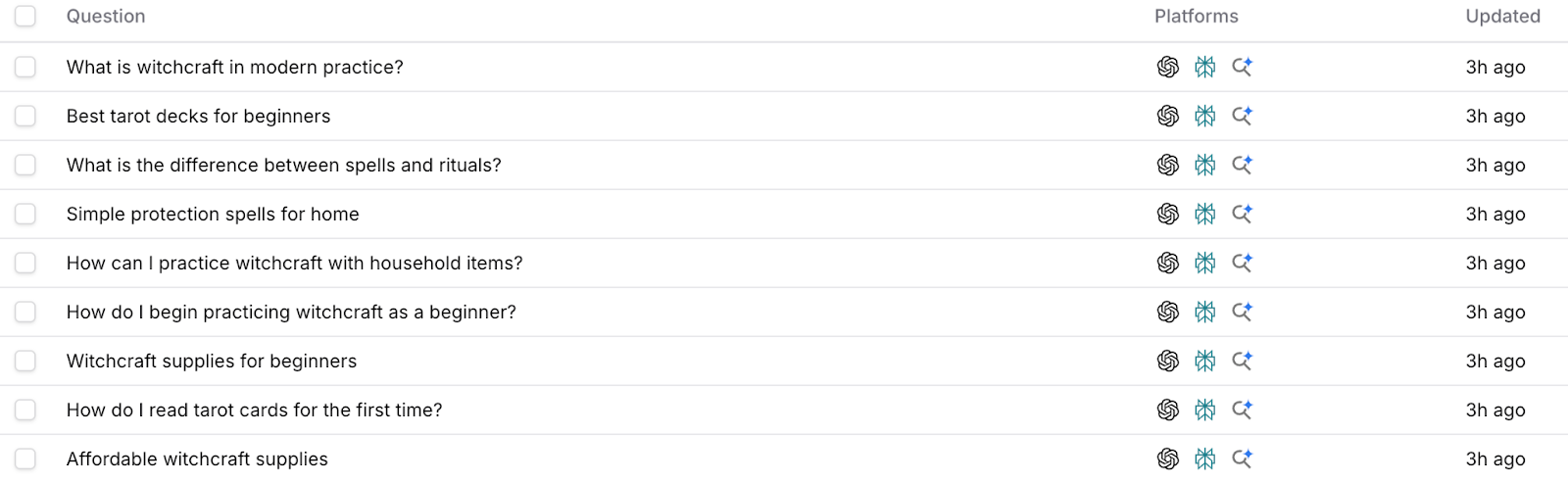
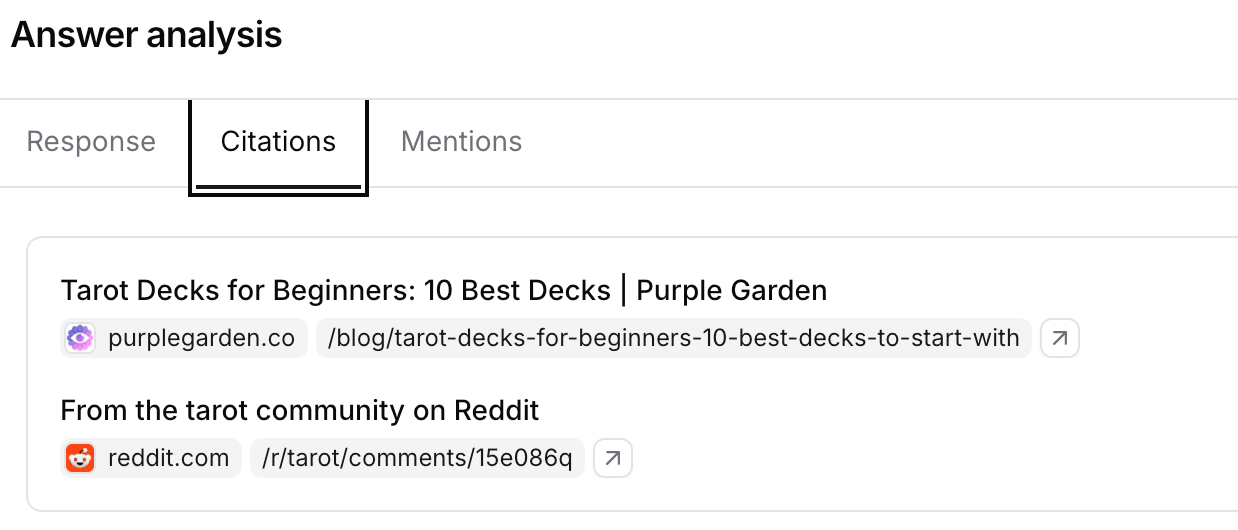
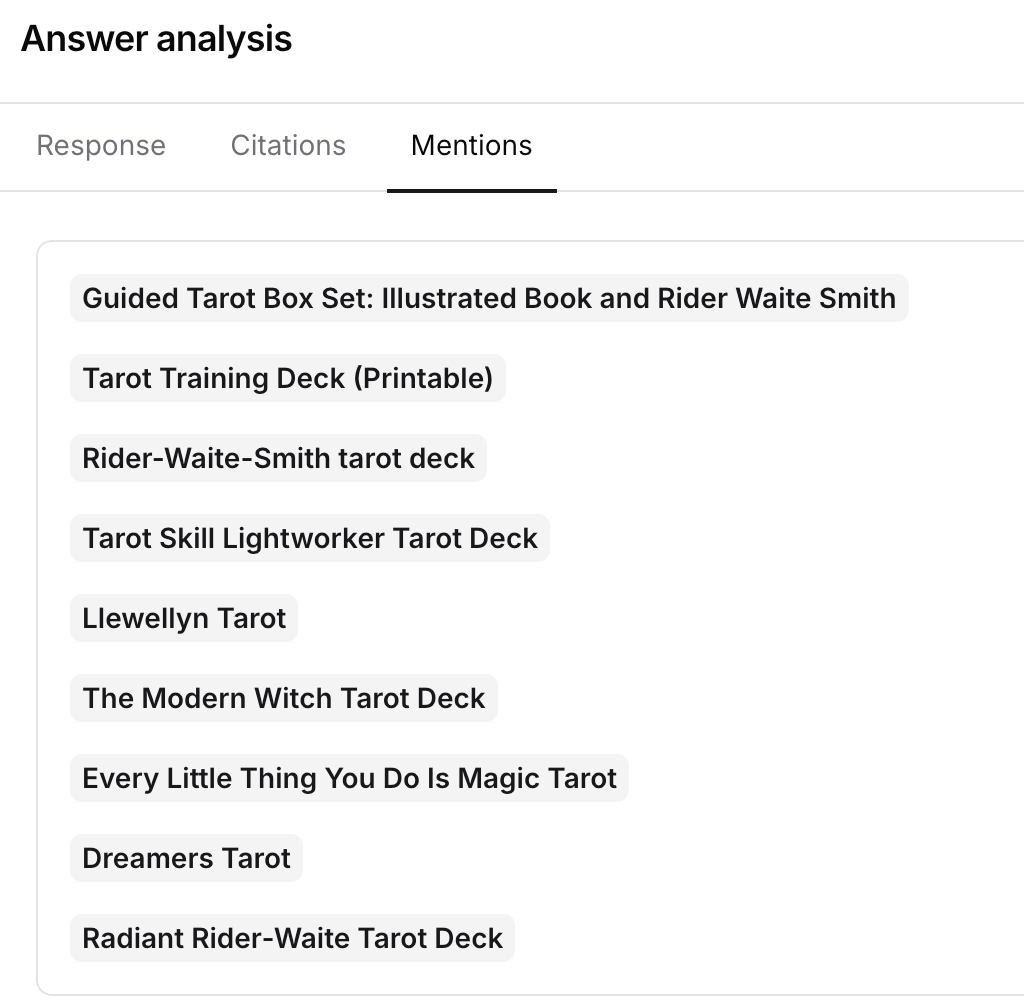
Once my questions were added, it took about eight or ten minutes for all three engines to scan and populate data for them. What’s really great about this particular insight is that it shows the results as they are for each engine (ChatGPT, Perplexity, and AIO), along with citations and mentions for each.
Why is this important, you ask? It’s insightful because every AI model has its own method and mechanics, and the results between each are never exactly the same.
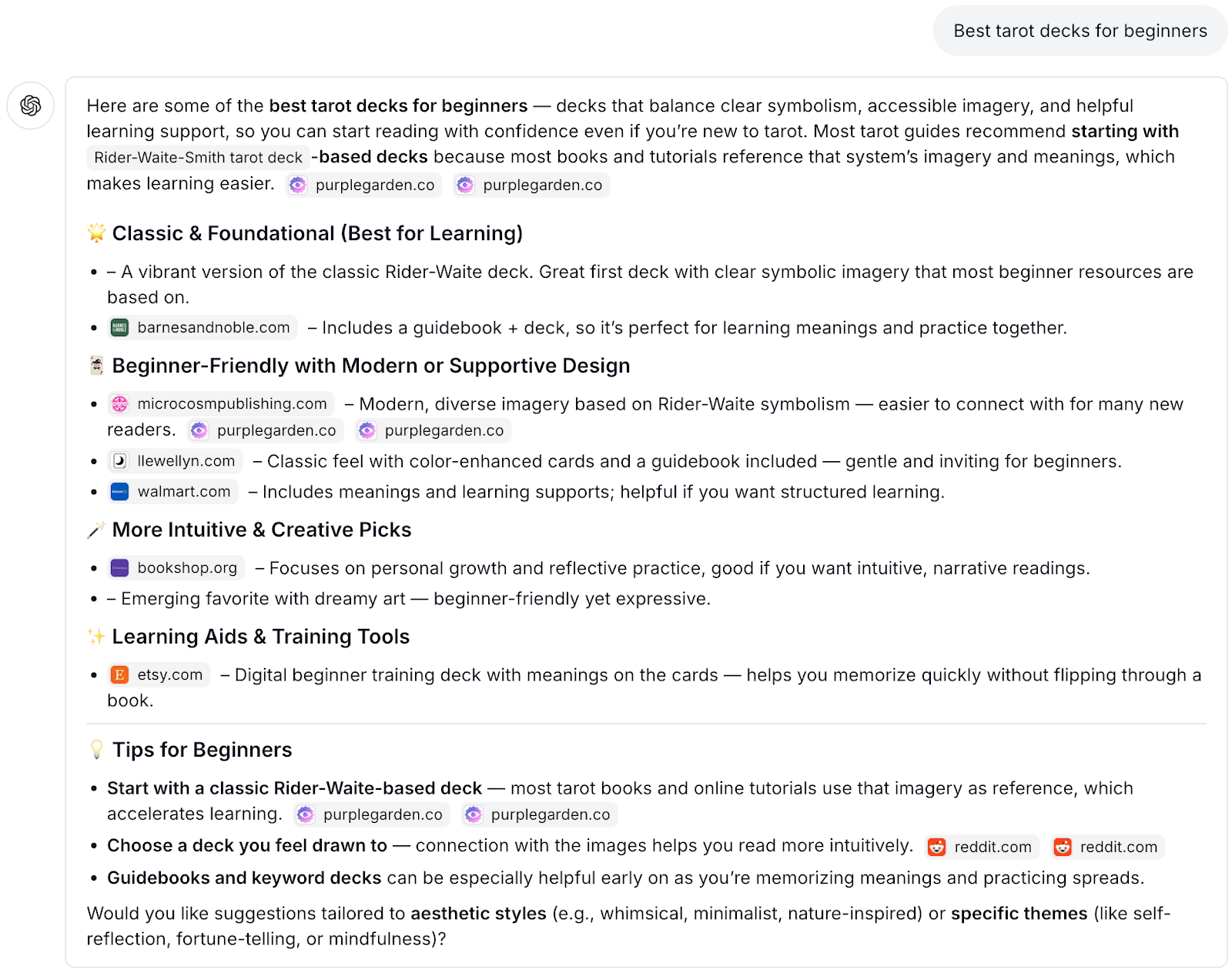
For “best tarot decks for beginners,” as an example, this is what ChatGPT said:
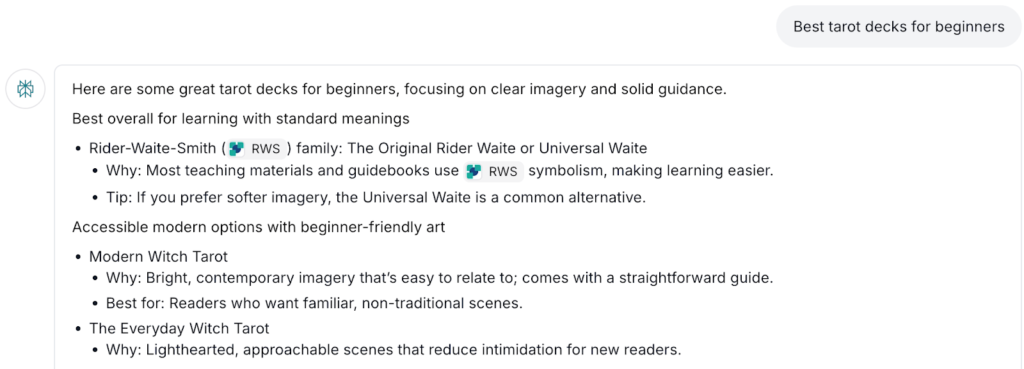
While Perplexity focused on:
And Google AIO started with:

As you can see, the same question got different answers from all three engines. But each entry provided insight into the citations and mentions as well, so I could see was being sourced:
And also what brands/products were mentioned in the result:
When you’re trying to optimize your own visibility, this sort of insight is incredibly valuable.
Beyond the questions you track, Hall provides a lot of various reports in the dashboard relating to:
- Visibility:
- Mentions
- Share of voice
- Mention position
- Regions
- Topics
- Citations:
- Top domains
- Domain position
- Top pages
- Page mentions
- Page categories
- Domain categories
- Web search
- Questions:
- Search demand
- Sentiment:
- Thematic analysis
If that sounds like a lot, that’s because it is (but that’s a good thing). You can click on any report in the left-hand toolbar to inspect the data more closely.
As someone in the building-content stage, my favorite Hall reports include the top pages (showing which pages that are driving the most citations in AI conversations), page categories (the types of pages driving the most citations, such as Reddit community posts, articles, or YouTube videos), and perhaps most importantly, search demand.
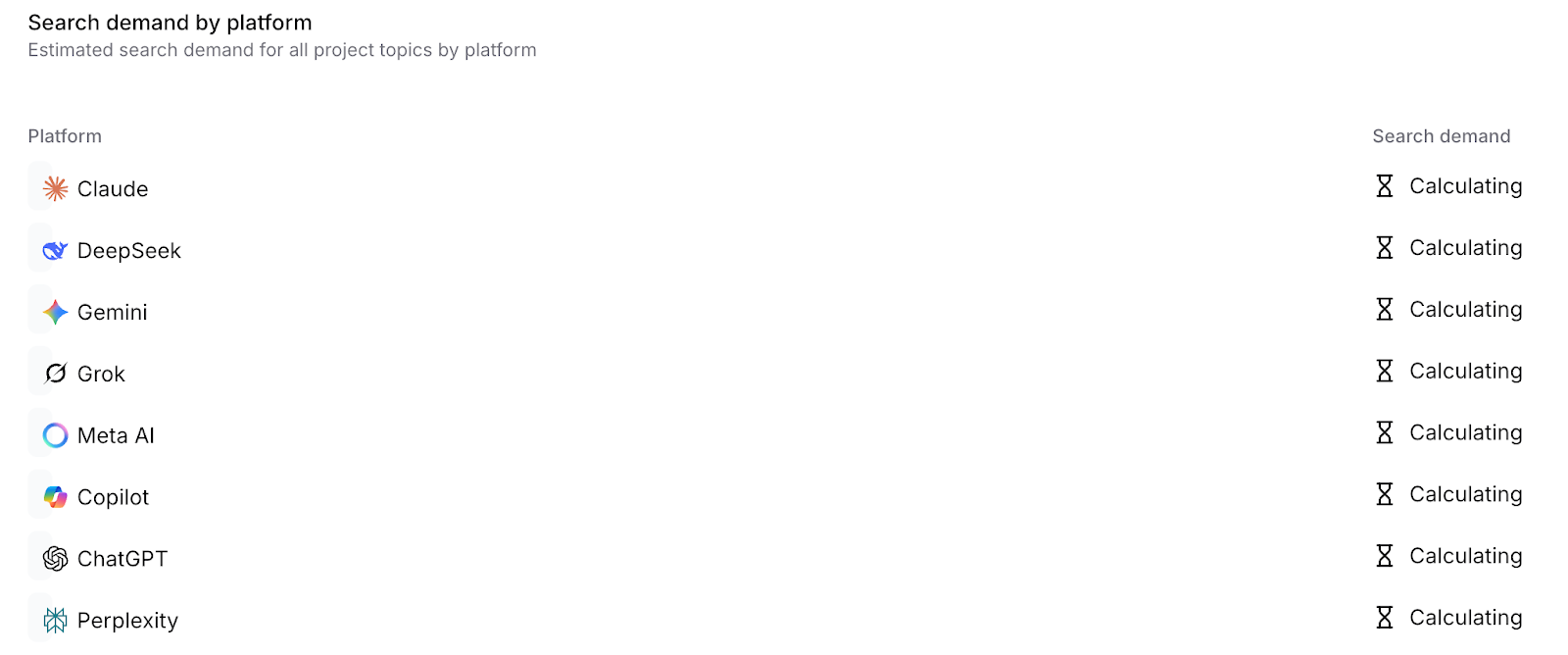
I’m an SEO-nerd familiar with keyword planning, so the search demand report really tickles my fancy because it offers insight into how often people are asking questions about topics relating to my niche. This is calculated by a “proprietary model” Hall uses, and shows search demand by topic, by specific AI platform, and even provides demographic and regional insights.
But beyond the functionality, I think the thing I appreciate most about Hall is that the UI is extremely easy to set up and navigate, even if you’ve never used an AI visibility tool before.
I’ll be honest: when I first signed up for Hall and started using it, I didn’t read a single how-to article or tutorial document beforehand because I wanted to gauge how beginner-friendly it actually is.
I give it a 10 out of 10 in that regard. Hands-down.
Hall AI Pros & Cons
Hall can be a great solution for brands and marketing teams who want to monitor their AI visibility, but it’s not necessarily going to be perfect for every single use case.
Hall AI Pros:
- Comprehensive AI visibility tracking across major AI platforms, monitoring real questions that are being asked by users.
- Detailed analytics and reporting provide data on citations, mentions, and even agent interactions so you can improve your own content strategy.
- Search demand reporting lets you see how often people are asking questions relating to your niche, informing future content creation or optimization.
- Offers AI site analytics to track agent activity and traffic referrals.
- Pretty intuitive interface that’s very user-friendly, especially for beginners.
- Affordable entry compared to other enterprise tools, especially since it offers a completely (although limited) free tier.
Hall AI Cons:
- Limited contributor seats available, which can hinder marketing teams that require more access on a plan.
- Very steep price jump between the free tier and first paid tier, which starts at $199 per month.
- Not all AI engines are included in tracking; the Lite (free) and Starter ($199/mo) tiers only offer tracking in ChatGPT, Perplexity, and Google AIO. The business tier (starting at $500/mo), provides access to more, which includes Google AI Mode, Gemini, Claude, Copilot, and DeepSeek.
Hall AI vs. The Competition
- Peec AI is probably the closest 1:1 competitor of Hall AI, and like Hall, it can be a great fit if you want to monitor your brand’s visibility, sentiment, and positioning with a very minimal learning curve involved.
- LLMrefs is a close second as a light, budget-friendly visibility AI tracker, but it also includes some other tool extras like the AI Content Humanizer (for humanizing content written by ChatGPT), a content Optimizer (for optimizing content for AI search engines), and even a Reddit Threads Finder.
- Otterly AI is another beginner-friendly AI search visibility tool that tracks multiple engines and has a low-priced entry-level tier for those just starting out or who only need minimal monitoring.
- Rankability is most similar to LLMrefs, in that it provides AI visibility analysis, along with additional tools like content optimization, AI SEO writing, and a keyword finder
Hall AI Pricing
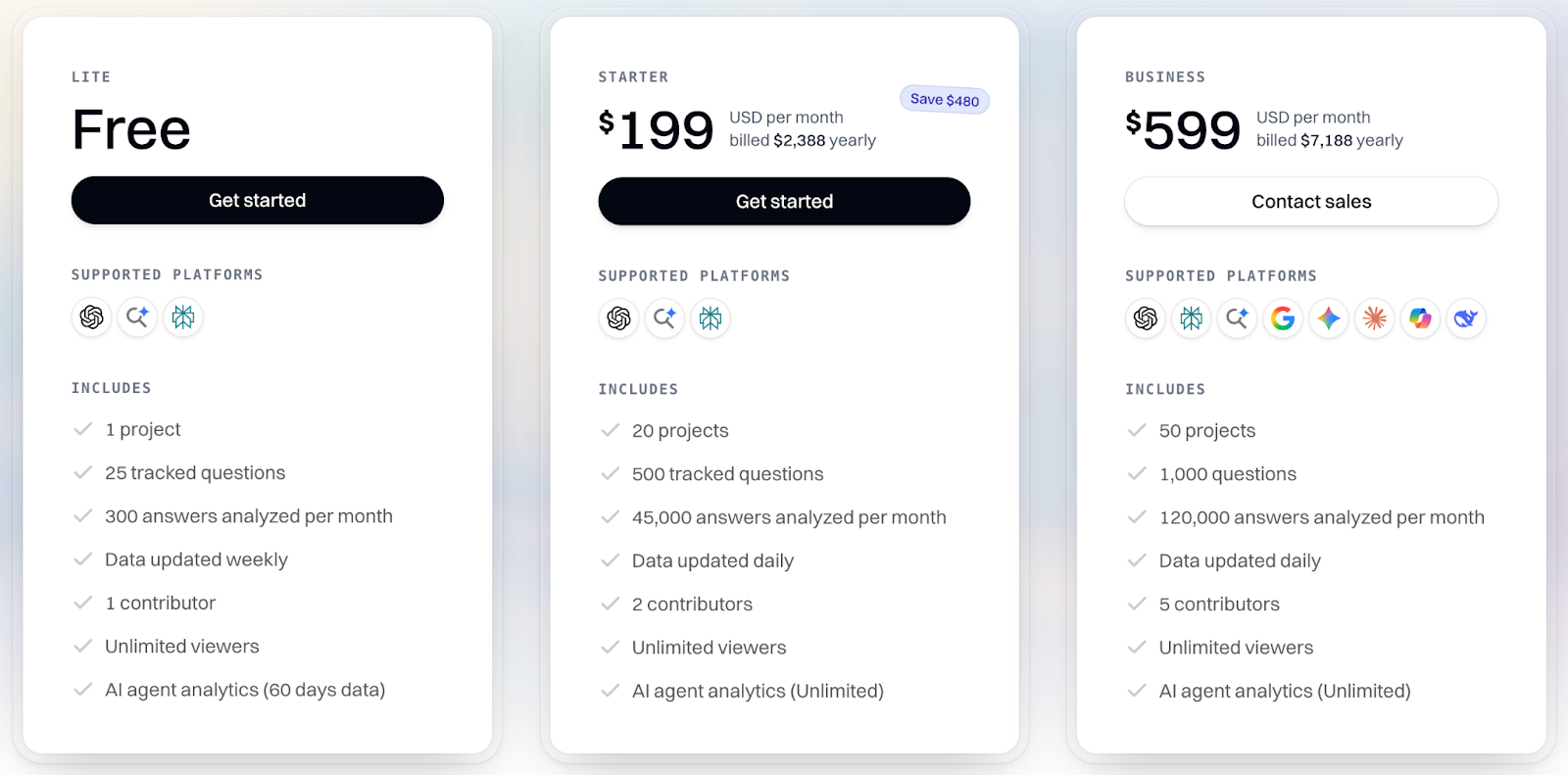
Hall offers several access tiers to suit a brand’s needs but the biggest ones (Business and Enterprise) are a considerable investment, especially for smaller brands or startups.
The Lite plan is free and lets you create one project (site) with up to 25 tracked questions across ChatGPT, Perplexity, and Google AIO. Data is updated weekly, and it analyzes 300 answers each month.
The next plan is the first paid tier, Starter, which is priced at $199 per month and covers ChatGPT, Perplexity, and Google AIO. This includes 20 projects, 500 tracked questions, 40,000 answers analyzed each month, with data updated daily.
The Business tier is $599 a month and supports ChatGPT, Perplexity, Google AIO, Google AI Mode, Gemini, Claude, Copilot, and DeepSeek. At this level, you can have up to 50 projects with 1,000 questions, 120,000 answers analyzed monthly, and data updated daily.
Finally, the Enterprise tier starts at $1,499 per month and includes API access, customized plan usage, unlimited historical data, and enterprise-grade security.
So, there are plenty of options to consider no matter what size your brand is currently, or how quickly it’s growing.
The Final Verdict
Hall AI offers really clear and actionable insight into understanding how AI systems are referencing, summarizing, and recommending brands. I especially appreciate how user-friendly it is, given that the dashboard and reporting are pretty easy to figure out, even if you’re totally new to this.
And yes, everyone loves free stuff and the entry-level Lite tier is a boon in that regard. That said, pricing and collaboration limits on the paid tiers might put it a bit out of reach for smaller teams or startups. The depth of Hall AI’s data, particularly the search demand visibility, however, makes it a solid option to consider for any brand seeking to move toward an AI-first discovery strategy.
At this point in the game, I think that’s a must, no matter what AI visibility tool you choose in the end.