- Why Teams Look for Profound Alternatives
- How We Chose These Alternatives
- Glossary: The Language of AI Visibility Tools
- Quick Comparison: Profound Alternatives at a Glance
- Peec AI: Best for Affordable Multi-Engine Monitoring
- OtterlyAI: Best Budget Entry Point
- Gumshoe: Best for Periodic Audits Without a Subscription
- Scrunch: Best for Technical AI Crawler Accessibility
- AthenaHQ: Best for Enterprise-Grade Coverage at a Self-Serve Price
- AirOps: Best All-in-One Platform for Monitoring + Execution
- Writesonic: Best for Widest Engine Coverage + Built-In Content Generation
- Goodie AI: Best Consolidated Platform for Monitor + Optimize + Attribute
- Emberos: Best for Enterprise Orchestration and Governance
- Ahrefs Brand Radar: Best for Teams Already in the Ahrefs Ecosystem
- Semrush AI Toolkit: Best for Teams Already in the Semrush Ecosystem
- The Honorable Mentions
- Profound vs The Alternatives: Head-to-Head Comparisons
- How to Choose the Right Profound Alternative
- Frequently Asked Questions About Profound Competitors
- The Final Drop
TL;DR — which Profound alternative should you pick?
For affordable multi-engine monitoring, go with Peec AI ($95/mo, unlimited seats). To test the waters on the cheapest possible plan, start with OtterlyAI ($29/mo) or run a one-time audit with Gumshoe ($0.10/conversation).
For the broadest self-serve engine coverage and the most feature-comparable alternative to Profound, AthenaHQ at $295/mo is the closest match. If your visibility problem is technical — a JavaScript-heavy site that AI crawlers can’t parse — Scrunch with AXP is the specialist. For monitoring + content execution in a single platform, pick AirOps or Writesonic (which covers 9+ engines from $249/mo).
For a consolidated monitor + optimize + revenue attribution stack, Goodie AI delivers all three at $399/mo. For enterprise brand orchestration with autonomous agents, Emberos is the only tool in the category.
And if you’re already an Ahrefs or Semrush customer, Brand Radar ($199/mo per platform) or Semrush AI Toolkit ($99/mo per domain) keep AI visibility inside a familiar interface.
Achieving and maintaining visibility across multiple LLM platforms has become a non-negotiable component of most marketing strategies. Fortunately, an increasing number of platforms exist to accomplish just this — over 24 tools now offer some form of AI visibility monitoring, with the industry average landing around $337/month for a mid-tier plan (per Rankability’s January 2026 market survey).
Profound is one of the better-known tools for figuring out where you stand across AI platforms and what to do about it. It’s a very capable platform, with customers praising the depth of analytics, speed of measurable impact from LLM optimization work, and the quality of customer support. In February 2026, the company closed a $96 million Series C at a $1 billion valuation — cementing its category-leader status.
Profound tracks visibility across up to 10 AI engines at the Enterprise tier, surfaces content optimization opportunities automatically, and bundles article generation into its Growth plan. For enterprise teams with the budget and internal resources to act on the analytics, Profound delivers.
However, it has a few glaring shortcomings that keep it from being the end-all, be-all of LLM visibility tracking. As a result, many teams look for more affordable alternatives, platforms with extended content creation capabilities, or more agentic solutions with an integrated execution layer.
Why Teams Look for Profound Alternatives
Teams typically start looking for alternatives when they hit one of three walls.
Budget and Engine Coverage Limitations
Profound’s Starter plan, historically listed at $99/month, tracks ChatGPT only. That’s one engine out of the five or more that matter in 2026 — like running an SEO analysis that only checks a fraction of your target keywords and ignores the rest.
The Growth plan at $399/month adds Perplexity and Google AI Overviews and includes content generation, but this puts Profound at 2–4x the cost of competitors offering comparable or broader monitoring coverage. As of mid-2026, Profound’s official pricing page has moved to a demo-led model, meaning most buyers now need a sales call to see the real number.
Execution Gap
Profound shows where you stand, but it doesn’t provide workflows for content refresh, technical fixes, or scaled content production — a major limitation for teams looking for an end-to-end solution.
Profound has been shipping against this critique (Agents launched in late 2025 with CMS publishing, brand kit injection, and pre-built templates), but the platform still bundles execution as a service layer rather than providing native tools that let teams execute content and optimization work fully in-platform.
Lack of Autonomy
Enterprise brands managing visibility across dozens of product lines need systems that act on data automatically, not just dashboards. While Profound offers a strong visibility layer, it hasn’t yet moved into fully agentic or autonomous systems that can remediate or deploy fixes based on the analytics.
To be fair, the sector is still immature, and most platforms don’t yet provide this level of functionality — but it’s not unheard of.
How We Chose These Alternatives
Every tool below was evaluated against six criteria:
- Engine coverage — how many major LLMs the tool tracks natively, without paid add-ons
- Pricing transparency — whether the tool publishes real prices or forces a sales call
- Category fit — does it solve a specific problem Profound doesn’t (execution, autonomy, technical crawling)?
- Track record — customer base, funding, and time in market
- Team collaboration — seat pricing, workspaces, and agency-friendly features
- Actionability — whether the tool shows data only, or helps you do something about it
This isn’t a “top 20” list. It’s eleven platforms, each chosen because it represents a meaningfully different category of solution. Pricing was verified against each vendor’s live site in July 2026.
Glossary: The Language of AI Visibility Tools
The category has developed its own vocabulary, and vendors use terms inconsistently. Here’s a clean reference:
| Term | What It Means |
|---|---|
| Prompt | A single question sent to an LLM (e.g., “best CRM for startups”). Most tools price by prompt volume. |
| Engine / LLM | An AI platform like ChatGPT, Perplexity, Gemini, Claude, or Copilot. Most tools charge more for broader engine coverage. |
| Citation | When an AI response references or links to your brand, page, or content as a source. |
| Mention | When your brand name appears in an AI response, cited or not. |
| Share of Voice / Share of Prompt | Your brand’s presence in AI answers relative to competitors. Emberos coined “Share-of-Prompt” specifically for the AI-era equivalent of market share. |
| Monitoring | Passive tracking of visibility, mentions, and citations. Most tools stop here. |
| Optimization | Monitoring + tools to actively improve visibility (content creation, technical fixes). |
| Orchestration | Fully autonomous systems that detect issues, recommend fixes, execute, and govern compliance. |
| AXP (Agent Experience Platform) | Scrunch’s term for infrastructure that serves an optimized page version to AI crawlers. |
| Sentiment | How AI responses characterize your brand (positive, neutral, negative). |
Quick Comparison: Profound Alternatives at a Glance
The best way to think about this hunt for a better Profound is to look at these tools on a spectrum: those that monitor your AI visibility, those that help you optimize it, and those that orchestrate your brand presence autonomously.
With that in mind, here are eleven top tools grouped by category rather than ranked arbitrarily. All pricing verified July 2026.
| Tool | Category | Starting Price | Engines Tracked | Best For | Key Limitation |
|---|---|---|---|---|---|
| Peec AI | Monitoring | $95/month | 3 (+ paid add-ons) | Affordable multi-engine monitoring with unlimited seats | No content execution or optimization workflows |
| OtterlyAI | Monitoring | $29/month | 4 (+ paid add-ons) | Cheapest entry point for AI visibility tracking | Pure tracker; no recommendations or execution |
| Gumshoe | Monitoring | $0.10/conversation | 11 | Periodic audits without a subscription commitment | Costs scale unpredictably at high volume |
| Scrunch | Optimization | $250/month (annual) | 7 | Technical AI crawler accessibility (AXP) | AXP still in limited pilot; premium pricing |
| AthenaHQ | Optimization | $295/month ($245 annual) | 8+ | Broadest self-serve engine coverage; most feature-comparable to Profound | Credit-based pricing; ACE Citation Engine locked to Enterprise |
| AirOps | Optimization | ~$200/month | 4 (Pro tier) | Monitoring + scaled content production in one platform | No public pricing; steep learning curve |
| Writesonic | Optimization | $249/month (Professional GEO tier) | 9+ | Widest engine coverage + built-in content generation | GEO features locked to $249/mo Professional tier |
| Goodie AI | Optimization | $399/month (Explorer) | 11+ (incl. Rufus, Sparky) | Consolidated monitor + optimize + revenue attribution | Higher tiers gated behind demo; Explorer requires trial |
| Emberos | Orchestration | Custom | 50+ | Enterprise brand orchestration with autonomous agents | Enterprise-only; requires cross-team buy-in |
| Ahrefs Brand Radar | Monitoring | $199/month (per index) | 6 | Teams already using Ahrefs who want AI visibility overlaid on SEO data | $828+/month combined cost |
| Semrush AI Toolkit | Monitoring | $99/month per domain | 4 | Teams already using Semrush wanting AI visibility inside familiar interface | Per-domain and per-user pricing scales quickly |
Peec AI: Best for Affordable Multi-Engine Monitoring
Peec AI is a strong mid-tier monitoring option for teams that want daily AI visibility tracking without paying for execution features they won’t use. The Starter plan ($95/month) tracks brand visibility across ChatGPT, Perplexity, and Google AI Overviews. Additional engines are available as paid add-ons (starting at $35/month per engine on Starter).
Every plan includes unlimited seats, which is one of the most important differentiators in this market — most competitors charge per-seat or cap team members at a low number. Peec AI raised a $21M Series A in November 2025 (tripling their valuation to over $100M), and counts Wix, Glide, Merge, Brevo, Superside, n8n, and Attio among their customers.
Quick facts:
- Founded: 2024
- Starting price: $95/month (Starter, 50 prompts, 3 engines)
- Higher tiers: Pro $245/month (150 prompts), Advanced $495/month (350 prompts), Enterprise custom
- Free trial: Yes
- Best fit: Mid-market teams and agencies wanting affordable daily monitoring without per-seat pricing surprises
Pros
- Entry-level plan with 3-model tracking
- Unlimited seats on every plan
- Daily prompt monitoring
- Visibility and sentiment scores
- Competitive benchmarking
- Citation source analysis
- Direct Slack access to the founding team
Cons
- Simple dashboard reporting without additional features to explain why or execute fixes
- No automated optimization
- No technical auditing
- Additional engine coverage requires paid add-ons
- No public API on Starter
Not for: Teams that need content execution tools, enterprise compliance features, or a platform that goes beyond showing data.
OtterlyAI: Best Budget Entry Point
OtterlyAI costs $29/month and tracks four AI engines out of the box. If you’re not sure whether AI visibility monitoring deserves a budget line item, this is the lowest-risk way to find out.
The Lite plan includes 15 tracked prompts across ChatGPT, Google AI Overviews, Perplexity, and Copilot — four engines at roughly 30% of what Profound charges for one. Other plans scale up to 400 prompts with unlimited workspaces, unlimited team members, and a Looker Studio connector for custom reporting. Add-on engines like Google AI Mode and Gemini are available for an extra fee ($9–$149/month depending on plan).
Quick facts:
- Founded: 2023
- Starting price: $29/month (Lite, 15 prompts, 4 engines)
- Higher tiers: Standard $189/month (100 prompts), Premium $489/month (400 prompts), Enterprise custom
- Free trial: Yes
- Best fit: Budget-conscious teams, startups, and solo marketers testing AI visibility
Pros
- Cheapest transparent entry point in the category
- Brand Visibility Index that scores overall AI presence
- GEO URL audits that check how individual pages perform in AI
- Unlimited team members on every tier
- 50+ country tracking
- Clean UI and clear data presentation
Cons
- Few features outside of pure visibility tracking
- No content recommendations
- No optimization workflows
- API and MCP access locked to Standard tier and above
- Gemini and AI Mode are paid add-ons
Not for: Teams that need actionable recommendations or any form of content execution alongside monitoring.
Gumshoe: Best for Periodic Audits Without a Subscription
Gumshoe offers a pay-per-use model at $0.10 per conversation (one prompt sent to one AI model) with no subscription required and the first three report runs free. It tracks 11 AI engines — the widest engine coverage of any budget tool — including Claude, DeepSeek, AI Overviews, ChatGPT, Perplexity, Gemini, Grok, Google AI Mode, and Copilot.
Gumshoe’s core differentiator is its persona-based methodology: rather than scraping generic queries, it simulates how AI responds to specific buyer personas, so you’re seeing how your brand appears to the people you’re actually trying to reach. The platform has attracted over 7,500 brands and agencies. A typical comprehensive audit runs 250–300 conversations, putting a single deep-dive report in the $25–$30 range.
The catch: costs scale unpredictably. Running Gumshoe weekly across a few clients can put you at $450–$1,680/month with no fixed ceiling — hard to build a recurring retainer around. API access is also gated behind a custom-priced Enterprise plan.
Quick facts:
- Founded: 2024 (Seattle)
- Starting price: $0.10/conversation, first 3 runs free
- Higher tiers: Custom Enterprise (unlocks API, higher volumes)
- Free tier: Yes (3 free runs)
- Best fit: Periodic audits, agency prospecting, teams exploring AI visibility with zero subscription commitment
Pros
- No subscription required
- Widest engine coverage of any budget tool (11 engines)
- Persona-based conversation modeling (not generic prompts)
- Brand perception analysis, citation tracking, tactical recommendations
- Scheduled reports
- Trusted by 7,500+ brands and agencies
Cons
- Per-use costs add up quickly for daily or weekly monitoring
- API access locked behind Enterprise plan
- No sentiment tracking
- No GA4 integration
- No white-label reporting for agencies
Not for: Daily monitoring at scale. The usage-based model loses its cost advantage above ~$150/month in spend.
Scrunch: Best for Technical AI Crawler Accessibility
Scrunch sits firmly in the premium monitoring tier. Following a mid-2026 repricing and repackaging, the Starter plan now runs $250/month billed annually ($300 month-to-month) and includes 350 custom prompts, 1,000 industry prompts, and tracking across all 7 engines from day one.
Its Agent Experience Platform (AXP) is what really sets it apart. AXP detects when an AI bot visits your site and serves it an optimized, code-light version that AI crawlers can easily parse — rather than the JavaScript-heavy, interactive page that human visitors see.
If your visibility problem is fundamentally a crawling and rendering issue, Scrunch has a strong case. But note that AXP is still in a limited pilot as of mid-2026, and availability isn’t guaranteed for new customers. Hallucination detection, another Scrunch differentiator, is now locked to the Enterprise tier.
Quick facts:
- Founded: 2023
- Starting price: $250/month annual ($300/month month-to-month), Starter tier
- Higher tiers: Growth $417/month annual ($500/month), Enterprise custom
- Free trial: No
- Best fit: Companies with JavaScript-heavy sites where AI crawler accessibility is a known or suspected problem
Pros
- All 7 engines tracked on every plan
- 350 custom prompts + 1,000 industry prompts on Starter
- Citation and sentiment analytics
- AXP addresses AI crawler rendering issues at the infrastructure level
- Persona-based tracking (up to 5 personas on higher tiers)
- SOC 2 Type II compliant
- Strong G2 rating (4.6/5)
Cons
- AXP still in limited pilot (not guaranteed for new customers)
- Hallucination detection now Enterprise-only
- No free trial
- Extra seats cost $25/month each
- Focus on technical crawlability may not be a major factor for many brands
Not for: Teams whose visibility issues are content-related rather than technical. The $250/month premium over pure monitoring tools isn’t justified without the AXP use case.
AthenaHQ: Best for Enterprise-Grade Coverage at a Self-Serve Price
AthenaHQ is the most feature-comparable direct alternative to Profound at the self-serve tier. Founded in 2025 by former Google Search and DeepMind engineers and backed by Y Combinator (W25 batch), the platform tracks brand visibility across 8+ LLMs — including ChatGPT, Perplexity, Gemini, Claude, Copilot, and Grok — from day one on the entry plan.
The Self-Serve plan runs $295/month monthly or $245/month billed annually and includes 3,600 monthly credits (one credit = one AI response queried), granular authority and citation intelligence, dynamic AI crawling, AI blindspot detection, and unlimited seats with role-based access control. This is the broadest self-serve engine coverage on the market — most competitors require an Enterprise upgrade to unlock Claude or Grok tracking.
The catch: the credit model can make monthly spend less predictable than the sticker suggests. If you want to increase monitoring cadence, track more competitors, or lean harder on the Action Center, the plan can start feeling metered rather than fixed. The ACE Citation Engine — AthenaHQ’s most differentiated feature for tracing which sources influence AI recommendations — is Enterprise-only.
Quick facts:
- Founded: 2025 (YC W25 batch)
- Starting price: $295/month (Self-Serve, $245/month annual)
- Higher tiers: Enterprise custom
- Free trial: No
- Best fit: Mid-market to enterprise teams that want Profound-level engine coverage without the enterprise sales cycle
Pros
- Broadest self-serve engine coverage in the category (8+ LLMs including Claude and Grok)
- 3,600 monthly credits on the Self-Serve plan
- Action Center provides specific optimization steps (not just observations)
- Dynamic AI crawling and AI blindspot detection
- Unlimited seats with role-based access control
- Regional insights (60+ countries)
- SOC 2 compliance and SSO for enterprise procurement
- Strong G2 rating (4.6/5 across 32+ verified reviews)
Cons
- No free trial (a common complaint for a $295/mo entry point)
- Credit-based pricing can get metered at higher usage
- ACE Citation Engine, API, and BI integrations locked to Enterprise
- Learning curve for teams new to GEO tooling
- Founded in 2025 — shorter track record than incumbents
Not for: Teams looking for cheap monitoring, teams that need pay-per-use flexibility, or budget-constrained SMBs.
AirOps: Best All-in-One Platform for Monitoring + Execution
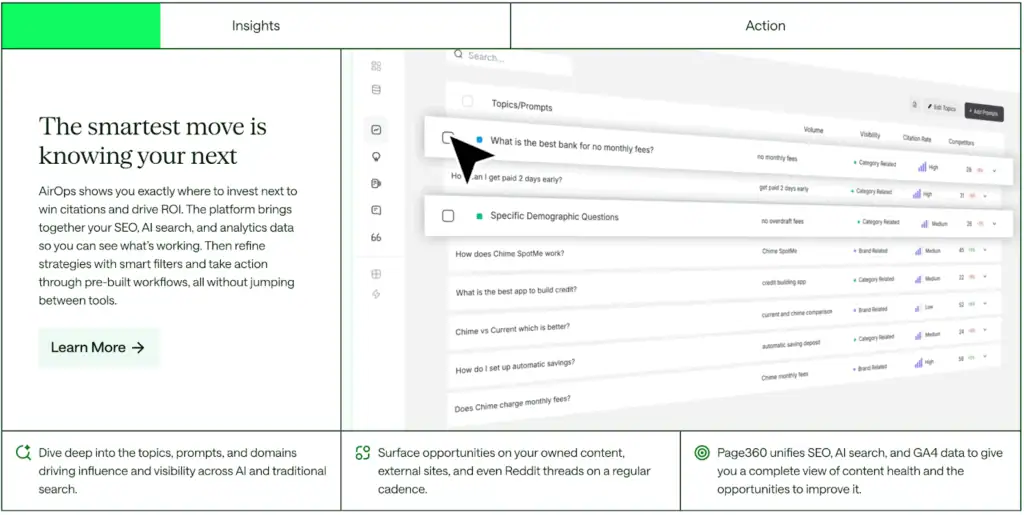
AirOps is the closest thing to a full-stack AI visibility platform in 2026.
Its Insights module tracks prompt visibility, surfaces opportunity reports, and provides page-level analytics. Its Actions module is where AirOps sets itself apart — task-based content creation and refresh workflows, CMS integrations (WordPress, Webflow, Contentful), brand knowledge bases that keep AI-generated content on-brand, and bulk optimization capabilities.
I’ve seen the AirOps workflow engine turn a content team’s monthly output from 10 articles to 50+. However, this comes at the cost of vague pricing and a steep learning curve. Power Agents and Grids (AirOps’ automation tools) require significant setup before producing useful output, and multi-engine access is locked to the Pro tier.
Quick facts:
- Founded: 2022
- Starting price: ~$200/month (Solo)
- Higher tiers: ~$2,000/month (Pro), Enterprise custom
- Free trial: Yes (limited free tier available)
- Best fit: Mid-size to enterprise teams wanting monitoring + scaled content production in one platform
Pros
- Prompt visibility tracking with opportunity reports
- Page-level analytics
- Task-based content creation and refresh workflows
- CMS integrations (WordPress, Webflow, Contentful)
- Grid-based workflow builder for content ops at scale
- G2 rating of 4.7/5 (130+ reviews)
- $600K+ in reported savings at LegalZoom (per AirOps case studies)
Cons
- No public pricing (requires sales conversation)
- Steep learning curve; typical 8-month time to ROI per G2 data
- Solo plan only includes ChatGPT (multi-engine requires $2K/month Pro)
- Overage billing at $0.025 per task beyond plan limit
- Big price jump between Solo ($200) and Pro ($2,000) with nothing in between
Not for: Teams that want simple monitoring dashboards, budget-conscious teams that can’t commit to a sales conversation, or organizations that prioritize broad engine coverage over execution capabilities.
Writesonic: Best for Widest Engine Coverage + Built-In Content Generation
Writesonic launched in 2020 as an AI writing platform and has since pivoted hard into GEO. In 2026, it positions itself as an “AI Search Growth Engine” that combines AI visibility monitoring with SEO tools and content generation and all in one platform. The current stack tracks 9+ AI platforms including ChatGPT, Perplexity, Google AI Overviews, Gemini, Claude, Copilot, Grok, and Meta AI — the widest engine coverage of any self-serve tool in the category.
The GEO features draw on a proprietary dataset of 120 million AI chatbot conversations for actual prompt volume data. For e-commerce brands, there’s also ChatGPT Shopping tracking to see how products appear in AI-generated shopping results. Once you identify visibility gaps, Writesonic’s AI agent can rewrite pages for GEO like adding FAQ blocks, comparison tables, and self-contained passages that AI engines tend to cite.
The catch: AI visibility features start at the $249/month Professional tier. The Lite ($49/mo) and Standard ($99/mo) plans are content-writing tools with no GEO monitoring. For teams whose primary need is monitoring, you’re paying for article credits you may not use.
Quick facts:
- Founded: 2020 (Delhi, India)
- Starting price: $249/month (Professional, unlocks GEO tracking)
- Higher tiers: Enterprise custom
- Free trial: Yes (limited)
- Best fit: Content teams wanting to combine AI visibility monitoring, SEO, and content generation in one platform
Pros
- Widest engine coverage in the self-serve category (9+ AI platforms including Claude)
- Proprietary 120M AI chatbot conversation dataset for prompt volume data
- Built-in AI content generation with GEO-optimized formatting
- Cloudflare-based crawler analytics
- ChatGPT Shopping tracking on higher tiers
- 1M+ registered users; 6-figure ACV case studies reported
Cons
- GEO features locked to $249/month Professional tier and above
- Monitoring-only teams pay for content credits they may not need
- Content tools originally designed pre-AEO can feel bolted-on
- Brand voice drift on long-form content
- Steep price jump from $99 Standard to $249 Professional
Not for: Teams that only need monitoring dashboards, or teams that want dedicated AEO precision over the widest possible engine coverage.
Goodie AI: Best Consolidated Platform for Monitor + Optimize + Attribute
Goodie AI is the closest thing to a single-tool Profound replacement outside the enterprise-only tier. The Explorer plan at $399/month bundles the full monitor-optimize-measure stack: AI Visibility Monitoring across 11+ AI platforms, an AI Optimization Hub with actionable recommendations, an AEO Content Writer for creating optimized content, Competitive Benchmarking, Sentiment Analysis, and Traffic and Attribution measurement that connects AI visibility improvements to actual conversions.
Goodie stands out for two reasons. First, engine coverage: it tracks ChatGPT, Perplexity, Gemini, Claude, DeepSeek, Grok, and, uniquely, agentic commerce surfaces like Amazon Rufus and Walmart Sparky. No other tool on this list covers those retail AI surfaces at the self-serve tier. Second, revenue attribution: unlike most monitoring tools that stop at visibility scores, Goodie ties AI mentions to completed purchases and conversion events.
Customer case studies cite meaningful results: NoGood reported 48 high-value leads in a quarter attributed to AI visibility tracked through Goodie; Dermalogica and SteelSeries also report conversion lift.
Quick facts:
- Founded: 2024
- Starting price: $399/month (Explorer, self-serve, 30-day money-back guarantee)
- Higher tiers: Pro and Enterprise (both demo-only)
- Free trial: Yes (with money-back guarantee)
- Best fit: DTC, e-commerce, and consumer brands wanting monitoring, optimization, and revenue attribution in one platform
Pros
- Broadest engine coverage in the category (11+ platforms including Rufus and Sparky)
- Consolidated monitor + optimize + attribute in one platform
- Revenue attribution ties AI visibility to actual conversions
- Built-in AEO content writer with recommendation engine
- 30-day money-back guarantee (rare in this category)
- Strong published case studies (NoGood, Dermalogica, SteelSeries)
- G2 rating 4.4/5
Cons
- Pro and Enterprise tiers gated behind demo (no transparent higher-tier pricing)
- Explorer at $399/month is higher entry than most monitoring-only tools
- Claude tracking fully unlocked only on Enterprise
- No published SOC 2 or HIPAA certifications
- Younger company (2024) with shorter enterprise track record
Not for: SMBs on tight budgets, teams that only need monitoring, or regulated industries requiring published compliance certifications.
Emberos: Best for Enterprise Orchestration and Governance
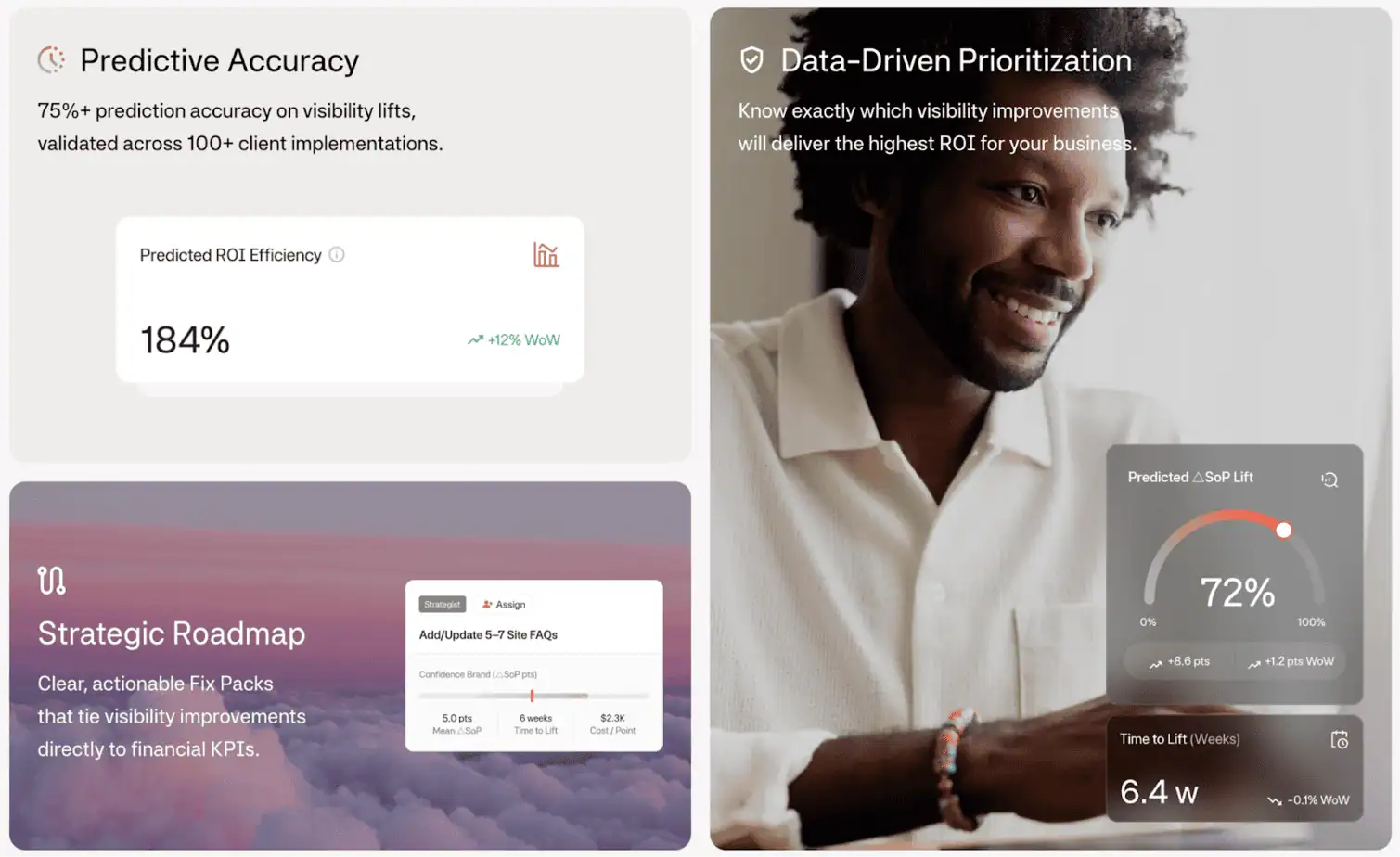
Emberos operates in a different category than every other tool on this list. Where monitoring tools show data and optimization platforms help you create content, Emberos orchestrates brand visibility autonomously across AI platforms.
Now monitoring 50+ AI models (including ChatGPT, Google AI Overviews, Claude, Perplexity, and Grok), Emberos describes itself as an “operating system for AI brand visibility,” using a five-agent architecture where specialized agents handle different functions:
- Scout — monitors 50+ AI models for brand mentions, visibility shifts, and competitor overlap
- Pilot — simulates fixes and predicts ROI with 70%+ accuracy before execution
- Flow — automates workflows and verifies lift via HubSpot, Slack, and Jira integrations
- Merchant — optimizes individual product visibility in AI shopping results (launched May 2026)
- Echo — ensures truth, compliance, and audit integrity across all AI channels
Emberos also uses a proprietary metric for measuring AI brand visibility: Share-of-Prompt (SoP). This metric quantifies your brand’s presence in AI responses versus competitors and relative to the “total opportunity space” — what Emberos calls “the AI-era equivalent of market share, but for conversational discovery.”
Quick facts:
- Founded: 2024 (founded by former Google exec Justin Inman)
- Starting price: Custom (based on number of agents deployed)
- Free trial: No
- Best fit: Large enterprises managing brand reputation at scale across AI platforms
Pros
- Autonomous brand visibility orchestration across AI platforms
- Five-agent architecture covering monitoring, prediction, automation, commerce, and governance
- Simulates fixes and predicts ROI before execution (70%+ accuracy)
- Governance layer ensures actions stay within brand guidelines (GDPR, CCPA)
- Merchant module tracks SKU-level Product Recommendation Rate with reported +8% PRR improvement per SKU
- Tracks 50+ AI models
Cons
- Pricing is fully custom across all tiers
- Enterprise-only focus
- Not for establishing initial AI visibility from scratch
- Not for SMBs or organizations without cross-functional alignment for deployment
- Young company (pre-seed funded January 2026)
Not for: SMBs, teams establishing initial AI visibility, or organizations without cross-functional alignment for enterprise platform deployment.
Ahrefs Brand Radar: Best for Teams Already in the Ahrefs Ecosystem
Ahrefs Brand Radar is the simplest option for teams that already pay for Ahrefs and want AI visibility data without adding another vendor to their stack.
Brand Radar tracks a database of nearly 200 million search-backed prompts across six platforms: AI Overviews, AI Mode, ChatGPT, Copilot, Gemini, and Perplexity. Unlike many AI visibility tools that generate synthetic prompts, Brand Radar uses prompts derived from actual user behavior, not hypothetical queries the tool decided to test. It also recently added YouTube and Reddit mention tracking — surfaces highly correlated with AI visibility.
Individual platform indices are $199/month each, or the all-platform bundle costs $699/month. Brand Radar requires an active Ahrefs subscription ($129+/month minimum), bringing total costs to $828–$1,148/month depending on configuration.
Quick facts:
- Founded: Ahrefs launched 2011; Brand Radar rolled out through 2025
- Starting price: $199/month (single-platform index) + $129/month Ahrefs base
- All-platform bundle: $699/month + $129/month Ahrefs base = $828/month minimum
- Free trial: Limited free access for Ahrefs users
- Best fit: Ahrefs power users who want AI visibility data integrated into their existing SEO workflow
Pros
- Simplest option for existing Ahrefs users
- Tracks AI Overviews, AI Mode, ChatGPT, Copilot, Gemini, and Perplexity
- Based on search-backed prompts derived from actual user behavior
- AI visibility data overlaid against traditional SEO performance in the same interface
- Now includes YouTube and Reddit mention tracking
- Largest prompt database in the category
Cons
- High combined cost ($828+/month for full setup)
- Documented accuracy gaps in independent testing (Writesonic January 2026 testing found Brand Radar reported ~3 ChatGPT mentions vs. 123 actual, and ~6 Perplexity vs. 212 actual)
- No native Claude or Grok tracking
- 2,500 monthly prompt check cap on base bundle
- No persona-based prompt generation
Not for: Teams that don’t already use Ahrefs. The combined cost is the highest on this list for what’s primarily a monitoring add-on.
Semrush AI Toolkit: Best for Teams Already in the Semrush Ecosystem
If your team already lives in Semrush, the AI Visibility Toolkit is the cleanest way to add AI search tracking without adopting another vendor. Semrush’s AI Visibility Toolkit costs $99/month per domain (annual billing) and delivers Visibility Overview, Prompt Research, Competitor Research, Brand Performance, and AI Search Site Audit reports — all sitting on top of Semrush’s 239M+ prompt database with daily refreshes.
Engine coverage is more limited than dedicated AEO tools: Brand Performance reports currently cover ChatGPT, Google AI Overviews, Google AI Mode, and Gemini, with Perplexity available in some reports. Claude and Grok aren’t natively supported at the self-serve tier.
The toolkit is a per-domain add-on: $99/mo covers one domain, 25 tracked prompts, and one user. Extra domains cost $99/mo each, extra users add $99/mo each, and extra prompts run $60/mo for 50 more.
For teams already paying for a Semrush core plan or Semrush One, the marginal cost of adding AI visibility is straightforward. For agencies with multiple client domains, the per-domain pricing can climb quickly.
Quick facts:
- Founded: Semrush launched 2008; AI Visibility Toolkit rolled out 2025
- Starting price: $99/month per domain (annual billing)
- Requires: Semrush core plan ($139.95/month minimum) or Semrush One ($199+/month)
- Free trial: 7-day trial available
- Best fit: SEO teams already using Semrush, wanting to add AI visibility inside the same interface
Pros
- Cleanest option for existing Semrush users
- 239M+ prompt database with daily refreshes
- AI Search Site Audit points to technical blockers
- Full workflow integration with SEO reports, Position Tracking, and Site Audit
- Rated 4.5/5 on G2
- 7-day free trial available
Cons
- Requires an active Semrush subscription (not a standalone option)
- Per-domain and per-user pricing scales quickly for agencies
- Limited engine coverage vs. dedicated AEO tools (no native Claude or Grok tracking at self-serve)
- Prompt limits (25 on base plan) require paid extensions
- No pay-per-use tier
Not for: Teams that don’t already use Semrush, or teams needing broad engine coverage including Claude and Grok at self-serve pricing.
The Honorable Mentions
These are some options we’ve tried a bit or are on our radar, but we haven’t had enough time to really dig into just yet.
- Promptwatch: I like what they’ve built and some of our clients use them. This is one I’m currently testing and will add to the list. So far: good clean UX and and decent source based analysis. Feels similar to Peec without the bloat of Profound, Scrunch, Athena.
- Visto: Hyper targeted to agencies, I considered them for a bit but realized they are more designed for general marketing agencies who want to offer some sort of AI visibility as a service. I need to check back in to see where they are at.
- Hall: Recently acquired, but a useful tool I used in the early days. I’m hoping they get to continue developing as an AI visibility platform after the Tracksuit acquisition.
- Rankability: On my radar as it’s specifically built for agencies, but I haven’t demo’d it yet.
- Rankscale: One of the first AI visibility tools I tried. They have a unique credit based pay-as-you-go pricing structure. May be a good option if you are unsure of usage patterns but want to try a visibility tool without getting locked in.
Profound vs The Alternatives: Head-to-Head Comparisons
Most articles stop at individual profiles. Here are the direct matchups worth thinking through:
Profound vs Peec AI
Both are pure monitoring plays, but the pricing gap is enormous: Peec’s Starter at $95/month tracks 3 engines with unlimited seats, while Profound’s Growth at $399/month tracks 3 engines but charges more as seats grow.
- Pick Peec if your primary use case is daily monitoring across a marketing team and you don’t need Profound’s Prompt Volumes data or enterprise reporting depth.
- Pick Profound if you need the panel-based Prompt Volumes dataset (real user query volumes across AI engines) that no competitor replicates.
Profound vs Scrunch
Both are premium monitoring tools with strong feature sets. Scrunch wins on engine coverage at the entry level (all 7 engines on Starter, versus Profound Starter’s ChatGPT-only) and offers AXP for technical crawler optimization. Profound wins on Prompt Volumes data, ChatGPT Shopping intelligence, and SOC 2 Type II procurement clearance for Fortune 500 buyers.
Profound vs AirOps
This is a category mismatch that reveals what Profound actually is. Profound is a specialized visibility monitoring platform with some execution bundled as a service. AirOps is a content operations platform with visibility monitoring layered on. Teams often run both, Profound for reporting to executives, AirOps for the actual content production and refresh work. If you can only pick one, choose based on your bottleneck: measurement clarity → Profound; content throughput → AirOps.
Profound vs Emberos
The clearest philosophical split in the category. Profound is a dashboard: it shows you what’s happening in AI search. Emberos is an operating system: it detects, predicts, executes, and governs autonomously. Emberos assumes an enterprise with cross-functional alignment and the organizational maturity to hand off decisions to AI agents. Profound assumes a marketing team that still wants human judgment in the loop. Both are enterprise-priced; the choice is about operational philosophy, not budget.
Profound vs Ahrefs Brand Radar
Both hit similar total costs ($828–$1,148/month for Brand Radar full setup, mid-four figures for Profound enterprise). Brand Radar wins if your team already runs Ahrefs and the marginal cost of adding AI visibility is what matters. Profound wins on data depth, prompt volume intelligence, and native Claude/Grok tracking (which Brand Radar lacks).
Profound vs AthenaHQ
This is the most direct like-for-like comparison in the category. AthenaHQ ($295/mo self-serve) tracks 8+ engines including Claude and Grok on the entry plan — broader engine coverage than Profound Starter or even Growth at the self-serve tier. Profound wins on Prompt Volumes data, ChatGPT Shopping intelligence, SOC 2 Type II compliance, and enterprise procurement support. If you’re a mid-market team that wants Profound-level engine coverage without the enterprise sales cycle, AthenaHQ is the strongest match. If you need panel-based real user query data or Fortune 500 procurement clearance, stay with Profound.
Profound vs Writesonic
Category mismatch, but often compared. Profound is a specialized visibility platform with some content execution bundled. Writesonic is a content platform with visibility monitoring bolted on. Writesonic wins on engine coverage (9+ vs. Profound Growth’s 3) and gives you content generation credits included in the same $249/mo bill. Profound wins on data precision, panel-based prompt volumes, and enterprise features. Choose Writesonic if content velocity matters more than data depth; choose Profound if the reverse.
Profound vs Goodie AI
Both are enterprise-priced consolidated platforms, but they solve different problems. Profound goes deeper on measurement and enterprise-grade data (SOC 2 Type II, HIPAA, Prompt Volumes panel data). Goodie AI goes broader on execution and attribution, including agentic commerce tracking (Rufus, Sparky) and revenue attribution that no other tool on this list matches. For DTC and e-commerce brands, Goodie’s agentic commerce tracking is often the deciding factor. For B2B and regulated industries, Profound’s compliance stack usually wins.
Profound vs Semrush AI Toolkit
Semrush AI Toolkit is Profound’s counterpart on the Semrush side. Semrush ($99/mo per domain) wins if you already pay for Semrush core: the marginal cost of adding AI visibility is minimal, and reports integrate cleanly with your SEO workflow. Profound wins on engine coverage (Claude, Grok natively) and Prompt Volumes data. For any team already running Semrush, add the Toolkit before evaluating standalone tools; for teams building from scratch, Profound or AthenaHQ offer more depth.
How to Choose the Right Profound Alternative
While it’s tempting to make a choice based on which dashboard looks best, it’s better to ask what you actually need to do with the data once you have it.
The answer falls into one of three categories: monitoring, optimization, and orchestration.
| Category | Monitoring | Optimization | Orchestration |
|---|---|---|---|
| What it does | Tracks brand mentions, visibility scores, and competitive positioning across AI engines | Monitoring + content creation, technical fixes, or workflow tools to improve visibility | Autonomous detection, remediation, governance, and compliance across AI platforms |
| Who it’s for | Teams establishing an AI visibility baseline or proving the business case for investment | Teams ready to act on visibility data with content or technical changes | Enterprise brands managing reputation at scale, fighting misinformation, and requiring compliance guardrails |
| Price range | $29 to $250/month | $250 to $2,000+/month | Custom enterprise pricing |
| Examples | Peec AI, OtterlyAI, Gumshoe, Ahrefs Brand Radar, Semrush AI Toolkit | Scrunch, AthenaHQ, AirOps, Writesonic, Goodie AI, Profound | Emberos |
Most teams should start with monitoring. You’ll learn more from 30 days of tracking data than from any amount of feature comparison. Once you know what problems you’re solving, you can decide whether you need optimization workflows or full orchestration.
If you’re still unsure which is the best fit, here’s a quick decision tree:
- If you’re just starting: OtterlyAI gives you four engines and clean dashboards for $29/month. Gumshoe lets you run a one-time audit for $25–$30 with zero subscription commitment. Either one proves (or disproves) the value of AI visibility tracking before you commit real budget.
- If you want reliable daily monitoring: Peec AI delivers the best balance of engine coverage, unlimited seats, and responsive support at a predictable monthly cost. This is where most mid-market teams should land.
- If you want the closest thing to Profound at a self-serve price: AthenaHQ tracks 8+ engines including Claude and Grok on the entry plan and includes an Action Center for optimization recommendations.
- If your site has technical crawling issues: Scrunch with AXP addresses AI crawler rendering problems at the infrastructure level. No other tool solves this specific problem.
- If you need monitoring plus content execution: AirOps combines visibility tracking with scaled content production workflows. Writesonic covers more engines (9+) at a lower entry point ($249/mo) and includes AI content generation.
- If you want monitoring, optimization, AND revenue attribution in one tool: Goodie AI is the strongest consolidated option — especially for DTC and e-commerce brands needing agentic commerce coverage (Rufus, Sparky).
- If you’re an enterprise managing brand reputation at scale: Emberos provides autonomous orchestration, predictive analytics, and governance capabilities that no monitoring or optimization tool can match.
- If you’re already an Ahrefs customer: Brand Radar keeps AI visibility data inside a familiar interface. But the combined cost ($828+/month) makes it hard to justify unless Ahrefs integration is a non-negotiable requirement.
- If you’re already a Semrush customer: The AI Visibility Toolkit at $99/mo per domain is the cheapest way to add AI tracking to an existing SEO workflow — but engine coverage is narrower than dedicated AEO tools.
Once you understand your specific visibility gaps and build a workflow for measurement and execution, you can choose the best tool for your long-term goals.
Frequently Asked Questions About Profound Competitors
What is the cheapest alternative to Profound AI?
OtterlyAI at $29/month is the cheapest subscription-based Profound alternative, tracking 4 AI engines with 15 prompts. For zero commitment, Gumshoe offers pay-as-you-go at $0.10/conversation with the first 3 report runs free — a full one-time audit typically costs $25–$30.
Is Profound worth the price?
Profound is worth it for enterprise teams that need Prompt Volumes data (panel-based real user query volumes), ChatGPT Shopping intelligence, SOC 2 Type II compliance, or Fortune 500 procurement support. It’s a hard sell for mid-market teams and agencies whose main need is broad engine coverage and predictable pricing — at that level, competitors like Peec AI, OtterlyAI, or Scrunch deliver more for less.
What’s the best Profound alternative for agencies?
Peec AI is the strongest agency choice at the monitoring-only tier: unlimited seats on every plan and dedicated agency pricing ($245/month). For agencies wanting monitoring plus scaled content production, AirOps offers agency plans with white-label options. For pure prospecting audits with no ongoing commitment, Gumshoe’s pay-per-use model works well.
What’s the closest feature-for-feature alternative to Profound?
AthenaHQ at $295/month is the most feature-comparable direct alternative. It tracks 8+ engines (including Claude and Grok) on the self-serve tier, includes citation intelligence, dynamic AI crawling, and an Action Center for optimization recommendations. Goodie AI at $399/month is the closest consolidated single-tool replacement if you also need revenue attribution and agentic commerce coverage.
How does Profound compare to Peec AI?
Profound offers deeper analytics, Prompt Volumes data, and enterprise features (SOC 2, procurement clearance) at $99–$399+/month. Peec AI offers a similar core monitoring feature set at $95/month with unlimited seats. For teams that don’t need enterprise-grade data depth or panel-based prompt intelligence, Peec is roughly 4x cheaper for equivalent monitoring capability.
Can I replace Profound with a single alternative?
Usually no, because Profound bundles monitoring, prompt data, and (increasingly) execution into one platform. Most teams that “replace” Profound end up assembling a stack: a cheaper monitor (Peec, OtterlyAI) plus an execution tool (AirOps) plus sometimes a governance layer. Emberos is the closest single-tool replacement, but only for enterprise buyers.
What AI engines should my tool cover?
The essential five in 2026: ChatGPT, Perplexity, Google AI Overviews, Claude, and Gemini. Copilot, Grok, and Google AI Mode are increasingly important. If a tool only tracks ChatGPT (Profound Starter, AirOps Solo), you’re missing 80% of the AI answer landscape.
How much does AI visibility monitoring cost on average?
Per Rankability’s January 2026 market survey, the industry average is $337/month for a mid-tier plan. Tools range from $29/month (basic, single-brand) to $15,000+/month (enterprise custom). Most mid-market teams should budget $200–$500/month for a properly scoped monitoring setup.
What’s the difference between monitoring, optimization, and orchestration tools?
Monitoring tools (Peec, OtterlyAI, Gumshoe, Brand Radar) tell you where you stand. Optimization tools (Scrunch, AirOps, Profound) add workflows or content production to help you improve. Orchestration platforms (Emberos) run autonomously: detecting issues, executing fixes, and governing compliance without human input at each step. Monitoring is a starting point; optimization is where most action happens; orchestration is enterprise-only.
Do I need to track my brand across every AI platform?
For most brands, tracking the top four (ChatGPT, Perplexity, Gemini, and AI Overviews) captures 90%+ of AI-driven search traffic. Add Claude and Copilot if you’re in B2B or enterprise segments where those tools have higher penetration. Emerging platforms (Grok, DeepSeek) are worth watching but rarely worth paying premium prices for at this stage.
How long does it take to see results from AI visibility optimization?
Expect 30 days to establish a baseline, 60–90 days to see meaningful visibility shifts from active optimization work, and 6+ months for compounding results. Anyone promising instant AI visibility improvements is either overselling or targeting a very narrow, low-competition query set.
The Final Drop
Once you understand your specific visibility gaps and build a workflow for measurement and execution, you can choose the best tool for your long-term goals. Profound may still be the right answer for some teams. Bu for most, one of the eleven alternatives above will deliver a better fit at a lower cost.