
AI visibility and AEO/GEO are moving fast.
Honestly, that’s an understatement.
Even for me, someone who’s spent nearly 20 years in digital marketing, content, and SEO, it’s been hard to keep up with all of the new tools, platforms, and strategies popping up.
Between keeping up with the work itself and staying on top of the latest tools (to say nothing of the shifts in AI itself), it’s like trying to keep up with two or three full-time jobs.
So, for this post, I want to keep it simple. I want to share my current understanding of the tools that are out there to help you make an informed decision about which platform or solution is the best fit for you and your team.
Here’s my latest analysis of the AI visibility tools on the market and what I’m recommending to clients and peers.
My 6 Favorite AI Visibility Tools (Side-by-Side)
| Tool | Primary Focus | Best For | Pricing |
| Scrunch | AI monitoring + Agent Experience Platform (AXP) for creating AI-friendly site versions | Agencies tracking multiple clients who want monitoring + optimization features; teams concerned about AI crawler access | $100/mo Explorer (ChatGPT only)$500/mo GrowthEnterprise: Custom |
| Peec AI | Straightforward multi-engine monitoring with daily tracking | Small in-house teams wanting simple, affordable tracking across major LLMs without complexity | €89/mo ($105 USD) Starter€199/mo ($235 USD) ProEnterprise: Custom+ Engine add-ons |
| Gumshoe AI | Usage-based AI visibility reports with no monthly subscription | Periodic audits, agency prospecting, beginners testing AI visibility before committing to subscription tools | Free (3 reports)$0.10/conversation pay-as-you-goEnterprise: Custom |
| Profound | End-to-end AEO platform combining monitoring + content generation + agentic workflows | Enterprise teams wanting integrated visibility tracking and AI-optimized content creation with strategic support | $99/mo Starter (ChatGPT only)$399/mo Growth (3 engines, 6 articles/mo)Enterprise: Custom |
| AirOps | Comprehensive platform blending AI visibility tracking (Insights) with content execution workflows (Actions) | Mid-size to enterprise companies ready to invest in both tracking and scaled content production with deep integrations | ~$199/mo Solo (estimated)~$2,000/mo Pro (estimated)Enterprise: Custom*All pricing custom/sales-led |
| emberos | AI brand visibility OS with autonomous detection, remediation, and governance | Large enterprises managing brand reputation at scale, fighting misinformation, needing predictive analytics and compliance | All plans custom:Essentials, Growth, Enterprise, Agency |
Scrunch
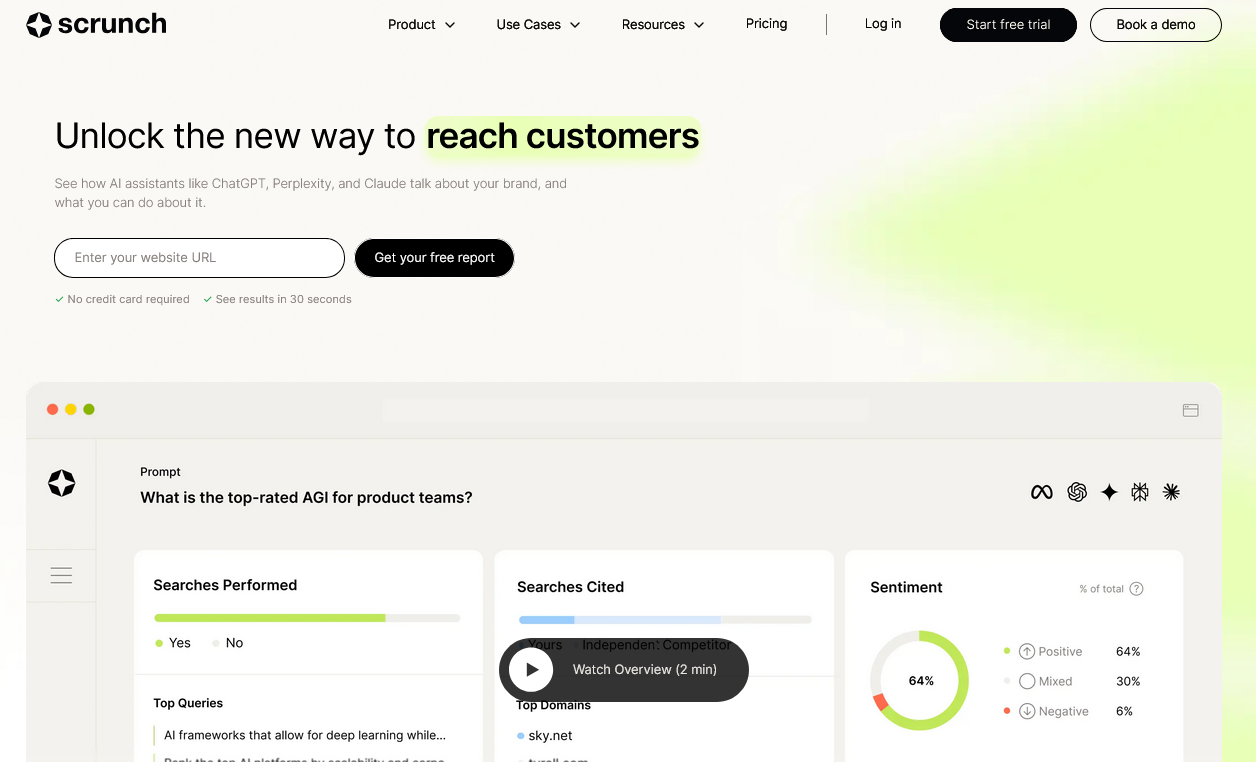
Scrunch positions itself at the intersection of AI visibility monitoring and “Agent Experience Platform” (AXP), offering tools to both track and optimize how your brand appears in AI-generated answers.
They offer some unique features. But, honestly, I would be a bit skeptical of the long-term value and viability of some of those differentiators.
The biggest differentiator, the “AXP” functionality creates separate versions of your content specifically for AI crawlers and LLMs. This feels a bit risky to me, as someone who has seen the rise and fall of many such strategies for improving SEO visibility.
Prompt volume and search trends are an interesting unique feature. But, I haven’t seen much evidence that this data is reliable enough to drive decision making or strategic investment.
Scrunch tracks:
- Explorer: ChatGPT only
- Growth+: ChatGPT, Gemini, AI Overviews, Google AI Mode, Perplexity, Copilot, Meta AI, Claude
Scrunch features:
- Citation analytics showing which pages get referenced
- Content recommendations to improve visibility
- Sentiment analysis across tracked prompts and topics
- Persona-based tracking (Growth tier includes up to 5 personas)
- Page audits to detect AI crawler blockers
- AI search trends and prompt volumes
- Agent traffic analytics (add-on)
- AXP features for creating a “parallel, AI-friendly version of your website” (add-on)
Scrunch pricing:
- Explorer: $100/mo – 100 prompts, ChatGPT only, 1 user, 3 page audits
- Growth: $500/mo – 700 prompts, all LLMs, 5 personas, 10 page audits, 5 users
- Enterprise: Custom – multi-brand, API access, SSO, dedicated support
Scrunch pros:
The AXP angle is unique. If you’re worried about how AI crawlers parse your site, Scrunch addresses that directly.
They also offer sentiment analysis, prompt volumes, and AI search trends. Most other platforms don’t offer these capabilities, even if their reliability may not be fully settled.
Scrunch cons:
The single-engine limitation on Explorer makes it a tough starting point unless you’re purely focused on ChatGPT. Growth at $500/mo is where the platform opens up, but that’s a significant jump. You’ll need enterprise for advanced features like full site audits and multi-domain agent tracking.
Scrunch feels well-suited for agency users who can absorb a higher price tag to track multiple client websites. But it’s probably not the best option for smaller teams and in-house marketers.
Peec AI
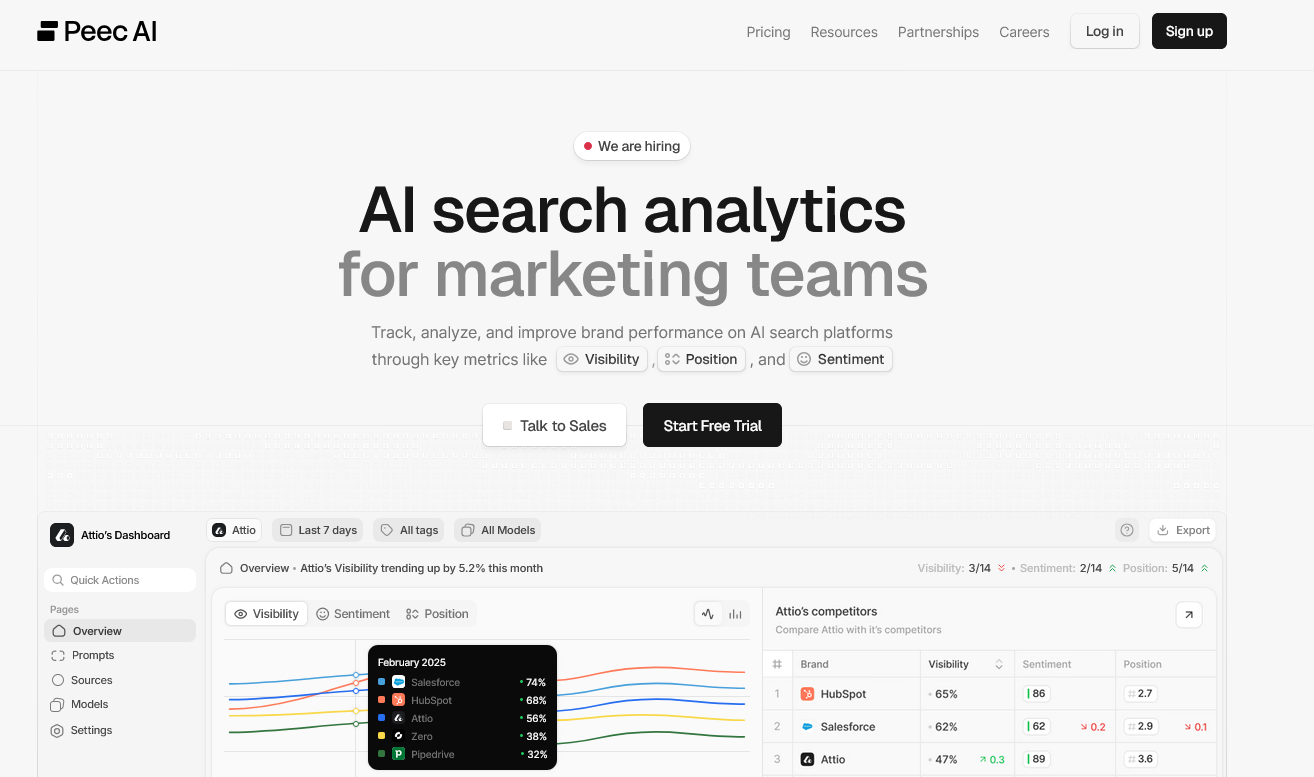
Peec AI tracks three engines (ChatGPT, Perplexity, AI Overviews) in the base plan and offers a simple add-on model for expanded coverage.
It offers a very straightforward set of tools for in-house teams to track visibility at a high level across the major models and AI surfaces. Notably, they offer unlimited user seats even at the lowest tier.
There aren’t a lot of frills added on, and it’s clear that Peec AI is positioned as a simpler (and cheaper) option to other tools that layer on features, but could come with added complexity for teams just looking for a tool that provides baseline data and analysis.
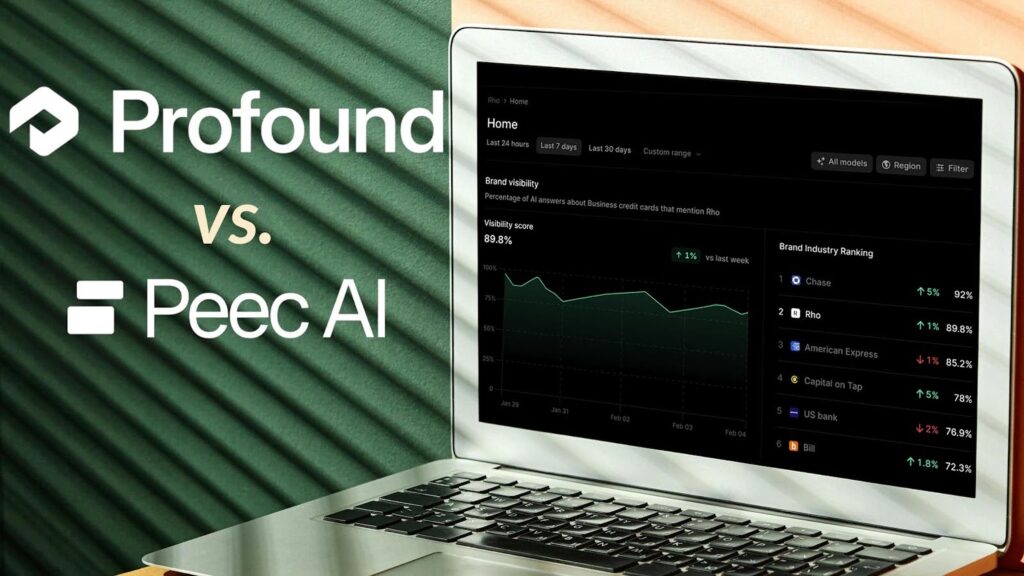
You might also be interested in: Profound vs. Peec AI for AEO: An In-Depth Comparison Before You Invest
Peec AI tracks:
- Base: ChatGPT, Perplexity, Google AI Overviews
- Add-ons: Gemini, AI Mode, Claude, and more
Peec AI features:
- Daily prompt monitoring across models
- Visibility, position, and sentiment scores
- Tactical recommendations for improving visibility
- Competitive benchmarking
- Prompt research and discovery (including prompt volume estimates)
- Citation analysis
- Unlimited countries and seats
- Agency pitch workspaces (for client prospecting)
Peec AI pricing:
- Starter: €89/mo (~$105 USD) – 25 prompts, 2,250 AI answers analyzed monthly
- Pro: €199/mo (~$235 USD) – 100 prompts, 9,000 answers monthly, Slack support
- Enterprise: Custom – 300+ prompts, 27K+ answers, SSO, dedicated account rep
- Add-ons priced separately for additional engines
Peec AI strengths:
Peec AI is one of the most entry-level-friendly options for small teams or even individuals looking for a straightforward solution to track and measure their visibility across the most popular LLMs and AI surfaces.
It has all of the tools you need at a pretty affordable price point relative to competitors.
Unlimited seats is a nice perk that no other tool currently offers.
Peec AI weaknesses:
Peec is more of a dashboard than a platform.
You get visibility and reporting, but less in the way of automated fixes or content recommendations. The “Insights” or “Actions” (they use both terms) provide broad stroke recommendations for new content creation and basic content optimization practices.
But Peec AI doesn’t seem to offer page-level analysis or recommendations for improving the visibility of your existing content.
Adding additional model tracking means additional costs, so it may make sense to opt for another option if you think you’ll outgrow the three included at the pro level.
Gumshoe AI
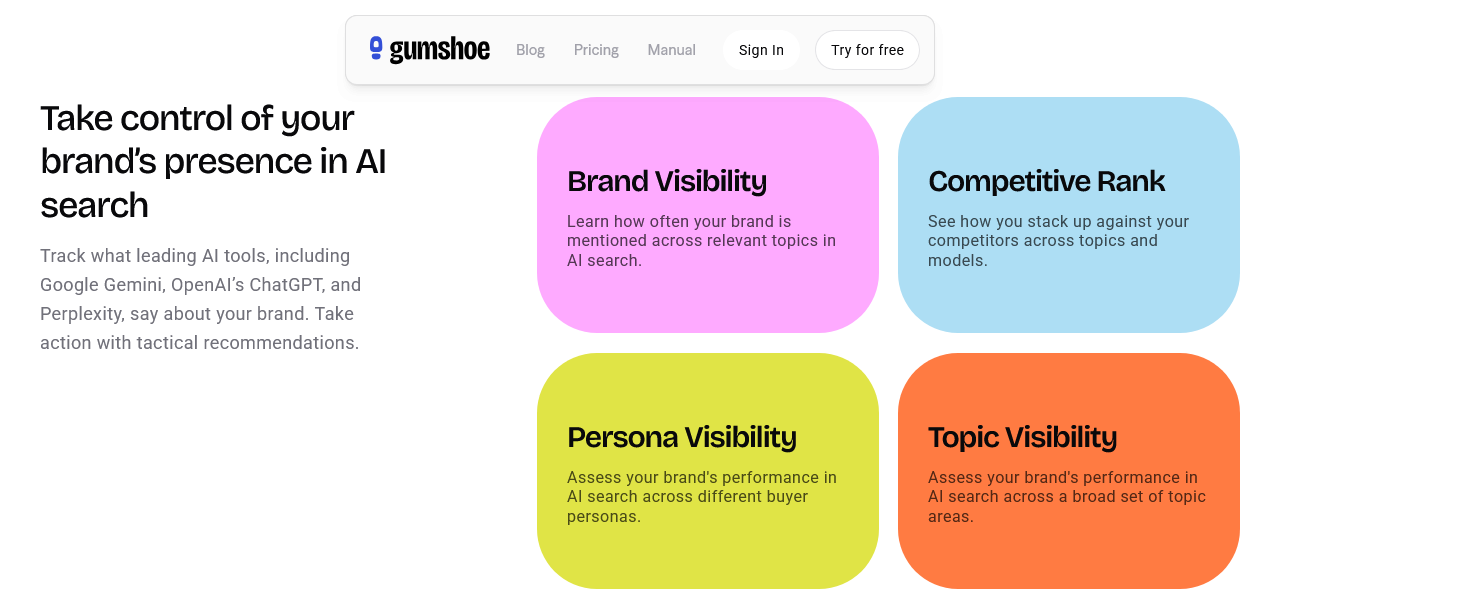
Gumshoe AI takes a radically different approach to AI visibility tracking: Usage-based pricing with no monthly subscription.
You pay only when you run reports and you’re charged per conversion (i.e., 1 prompt * 1 model), making it ideal for brands that want periodic checks rather than always-on monitoring.
This is one of the first AI visibility tools that I tested personally and it provided a lot of context for how the other tools work behind the scenes. If you’re still on the fence or trying to understand how to integrate AI visibility tracking into your workflow and strategy, tinkering with Gumshoe AI is a great starting point.
Gumshoe AI tracks:
- Claude, DeepSeek, AI Overviews, ChatGPT, Perplexity, Google Gemini, Grok
Gumshoe AI features:
- Unlimited brands, prompts, and personas (pay as you go)
- Brand perception (sentiment) analysis across AI models
- Top cited sources feeding AI responses about your brand
- Tactical recommendations for improving visibility
- Page audits
- Scheduled reports (pay-as-you-go and Enterprise)
- Tracked trends over time
- AI-assisted content generation
Gumshoe AI pricing:
- Free: First 3 report runs
- Pay-as-you-go: $0.10 per conversation analyzed
- Enterprise: Custom pricing with volume discounts, dedicated success manager, custom integrations/APIs
Gumshoe AI strengths:
The pay-as-you-go model is perfect for use cases that only require periodic reporting, for agencies looking to run one-off analysis for prospective clients, or for AI visibility beginners who want to make sure they understand the platforms before committing to a more robust tool.
Gumshoe AI offers nearly all of the same features as many of the leading tools, including prompt tracking across a variety of models, persona aggregation, competitor benchmarking, page audits, and more.
It also offers content generation, which allows you to feed opportunities directly from the visibility report into an LLM to generate targeted content. (Additional cost of ~$25 per piece of content generated.)
Gumshoe AI weaknesses:
Gumshoe AI feels a little less polished than some of the other tools.
While it has general feature parity, the dashboards and reporting are better suited for internal use than presenting to a sophisticated enterprise client.
The pay-as-you-go pricing can also add up quickly if you’re not paying close attention. $0.10 per conversation seems cheap, but if you’re tracking 50 prompts across 10 different models, that comes out to $50 per report; $200/mo if you’re running them once a week.
If you become a power user, you’d probably end up paying less with a monthly subscription to another platform.
Profound
Profound markets itself as an Answer Engine Optimization platform that covers monitoring, content creation, and agentic workflows.
As one of the early leaders in this space, Profound is definitely positioned more as a complete AI visibility platform versus a simple AI visibility tracker.
That’s apparent based on Profound’s latest pricing options, which now include optimized content generation along with platform access and AI visibility tracking.
While it remains on the premium side in terms of pricing, it isn’t the most expensive platform on the market. But the slightly lower price tag is offset by some limitations, such as only three supported models unless you opt for the Enterprise plan.
Profound tracks:
- Starter: ChatGPT only
- Growth: Perplexity, Google AI Overviews, ChatGPT (3 engines)
- Enterprise: Up to 10 Answer Engines (includes Gemini, Copilot, Meta AI, Grok, DeepSeek, Claude, Google AI Mode)
Profound features:
- Answer Engine Insights (brand and competitor visibility analysis)
- Agent Analytics (AI-sourced traffic tracking across domains)
- Prompt volumes
- Content generation and optimization agents
- Opportunities feed (auto-surfaced visibility gaps)
- AI Shopping tracking (Enterprise)
Profound pricing:
- Starter: $99/mo – 50 prompts (ChatGPT only), 1,500 responses/month, email support
- Growth: $399/mo – 100 prompts, 9,000 responses/month, 3 engines, 6 optimized articles/month
- Enterprise: Custom – 10 engines, tailored tracking, SSO, API, dedicated Slack support
Profound strengths:
Profound is one of the few platforms that offers both integrated AI visibility tracking and content generation.
The “Agents” functionality (automated content creation, content optimization, and opportunity detection) feel powerful. But, aside from the content creation itself, the functionality seems similar to the opportunities or actions surfaced by other tools.
The Enterprise offering is interesting as it blends software with AI-assisted services (“dedicated AEO strategist”) and deliverables.
Profound weaknesses:
Profound feels like a clear enterprise play that’s probably above and beyond what most teams will want and need.
Nearly all of their features are gated behind the $399 Growth plan, and even that tier seems to offer just a taste of the full functionality.
AirOps
AirOps blends AI visibility tracking (“Insights”) with content execution workflows (“Actions”), positioning as an end-to-end platform for teams that want to monitor and act on AI search opportunities at scale.
Admittedly, I was a bit skeptical of AirOps when it first emerged as primarily an AI-powered content creation platform. But they’ve since expanded beyond content creation workflows and offer a suite of tools for building, tracking, and optimizing AI visibility.
I’ve been impressed by some of their recent feature launches, too, which have filled in a lot of real-world gaps between AI visibility tracking, content production, and tracking.
AirOps tracks:
- Solo: ChatGPT only
- Pro & Enterprise: ChatGPT, Google AI Mode, Perplexity, Gemini
AirOps features:
- Insights: Prompt/page tracking, daily monitoring, opportunity reports (onsite + offsite), agent analytics
- Actions: Content creation/refresh, bulk optimization workflows, task-based execution (20K-75K+ tasks/month)
- Page360: Integrated, page-level analytics for tracking both SEO and AI visibility
- Brand kits, knowledge bases, CMS integrations (Webflow, WordPress, Contentful, etc.)
- SEO/AEO research integrations (Moz, Semrush, Ahrefs, DataForSEO)
- Team collaboration (unlimited seats on Pro+)
AirOps pricing (estimated):
- Solo: $199/mo* – 1,000-20,000 tasks/mo, 100 tracked prompts/pages, ChatGPT only, 1 user, monthly opportunity reports
- Pro: Custom (~$2,000/mo*) – 75,000 tasks/mo, 250 prompts/pages, multi-engine, weekly reports, unlimited seats, live cohort trainings
- Enterprise: Custom – Unlimited tasks/seats, custom limits, multiple regions/personas/languages, dedicated account manager, 1:1 onboarding
*Note: All AirOps pricing is technically custom. They don’t publish their pricing publicly. But based on analysis and discussion with their sales team, these are the estimated base prices for Solo and Pro tiers.
AirOps strengths:
AirOps is probably the most comprehensive, end-to-end platform for AI visibility tracking, management, and optimization.
No other platform offers the same breadth of tools and the same platform integration.
It’s especially well-suited for mid-size to enterprise companies who can invest in the platform for both tracking and content creation, which can offset costs and generate significant ROI.
AirOps weaknesses:
The biggest limitation of AirOps is pricing. They seem to go out of their way to obfuscate costs for each of their plans, and even a deep dive into the documentation makes it hard to know for sure what you’ll end up paying without talking to their sales team.
Part of the pricing structure is based on per-task billing for the Actions functionality, which means
Another limitation right now is that AirOps tracks the 4 big AI models, but even the Enterprise plan doesn’t support the long-tail LLMs such as DeepSeek and Grok.
For most teams, this is probably unimportant. But worth noting for teams who need visibility across a broader set of models.
emberos
Emberos positions itself as the “operating system for AI brand visibility,” going beyond monitoring to offer what founder Justin Inman calls “closed-loop AI brand orchestration.”
Comparing it to the other tools, it certainly feels the most ambitious in terms of capabilities and autonomous functionality. Most of the features center around AI-powered detection and remediation. It almost feels like an IT ops platform for AI visibility.
emberos is geared toward managing and governing AI visibility, battling misinformation, and standardizing brand messaging. This makes it best suited for brands with significant visibility to manage versus early-stage companies trying to establish themselves in LLMs.
emberos tracks:
- ChatGPT, Google AI Overviews, Claude, Perplexity, Grok
- Plans to expand into voice assistants (Alexa and similar)
- Monitors 50+ AI models via Scout agent
emberos features:
- Scout: Detects brand mentions, visibility shifts, competitor overlap across AI platforms
- Pilot: Simulates “Fix Packs” that predict ROI of visibility improvements with 70%+ accuracy
- Flow: Automates workflows via HubSpot, Slack, Jira integrations; applies changes and verifies lift
- Merchant: Optimizes individual products/SKUs in AI shopping environments
- Echo: Governance layer ensuring compliance, brand safety, and audit integrity
- Share-of-Prompt (SoP) metric tracking brand appearance frequency in AI answers across three tiers: Core (brand queries), Competitive (rival visibility), Category (market demand)
emberos pricing:
- Essentials: Custom pricing – Monitor brand mentions, Scout agent, Truth Packs for misinformation defense, basic dashboards, multi-language preview; best for mid-market/startups focused on reputation defense
- Growth: Custom – All Essentials + competitive/category monitoring, simulations with 75%+ accuracy, workflow automation; best for growing startups seeking category leadership
- Enterprise: Custom – All Growth features + cross-industry monitoring, full multi-agent system, crisis automation, custom dashboards, GDPR/CCPA compliance; best for large enterprises
- Agency: Custom – White-label, partner-managed support
emberos strengths:
emberos offers autonomous features, predictive analytics, and KPI forecasting that far exceed the functionality of any other tool on this list.
This functionality is especially powerful for enterprise marketers who need air-tight data and attribution to justify major investments in AI visibility tracking and optimization.
emberos weaknesses:
Zero pricing transparency. It’s unclear how pricing is structured or what to expect.
The breadth and sophistication of the platform seems clearly geared towards a sophisticated, big-brand buyer. And many of the most differentiated features seem like they would be overkill for a majority of marketing teams.
More AI Visibility Tools to Consider
While the tools above offer dedicated AI visibility platforms, several established players and emerging solutions provide alternative approaches worth evaluating:
Ahrefs Brand Radar
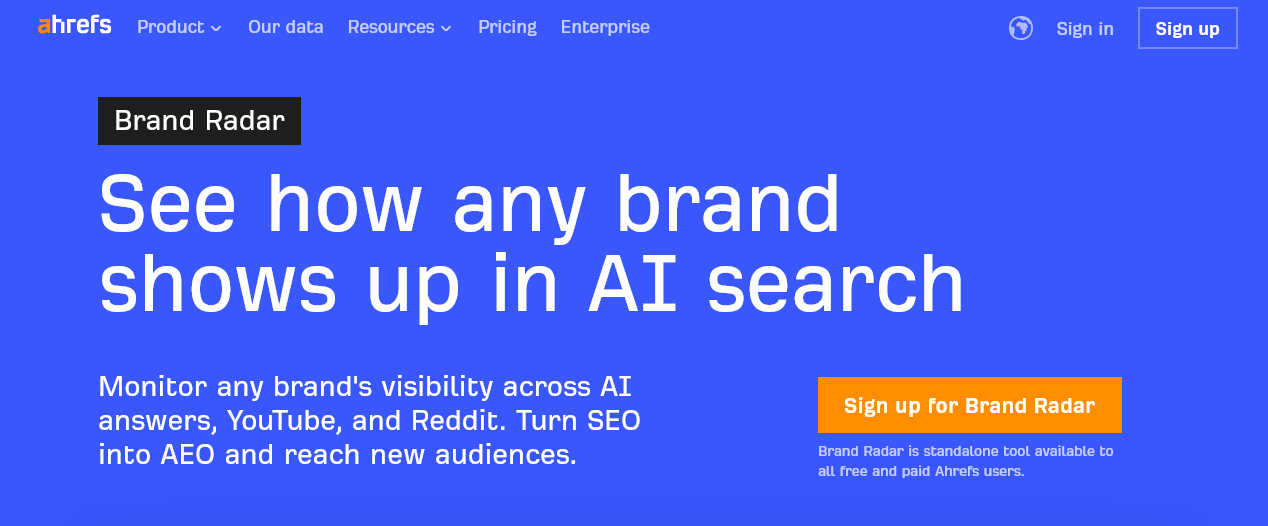
Ahrefs entered the AI visibility space with Brand Radar, tracking 267M+ monthly prompts across 6 AI platforms (AI Overviews, AI Mode, ChatGPT, Copilot, Gemini, Perplexity) using search-backed prompts rather than synthetic queries. Best for teams already invested in the Ahrefs ecosystem who want AI Share of Voice tracking alongside traditional SEO, though all-platform access costs $699/mo.
Semrush AI Visibility Toolkit
Semrush’s standalone toolkit ($99/mo) or bundled offering brings AI monitoring into their broader SEO suite with features like Visibility Overview, Competitor Research, Prompt Tracking, and AI Search Site Audit. Ideal for teams that want unified SEO + AEO reporting in one platform, but pricing and complexity increase quickly if you only need AI visibility without the full Semrush stack.
OtterlyAI
OtterlyAI offers straightforward prompt-based monitoring ($29-$489/mo) across ChatGPT, Google AI Overviews, Perplexity, and MS Copilot with add-ons for AI Mode and Gemini. It’s a clean, no-frills tracker with unlimited team members and workspaces on Standard+ plans, ideal for SMBs that want reliable visibility dashboards without execution complexity or premium pricing.
Goodie
Goodie positions as an end-to-end AEO platform combining monitoring, optimization recommendations, and growth measurement across LLMs and AI search engines, with pricing starting at 495/mo (with annual billing). Best for teams that want strategic guidance and execution support rather than just software, though the sales-led model and limited pricing transparency require upfront conversations to understand fit and investment.
Choosing the Right AI Visibility Tool: The Bottom Line
Committing to an AI visibility tool can feel like a difficult and fraught decision.
Things are changing and evolving so quickly, it’s like trying to jump onto a speeding train.
But that’s exactly the reason it’s so important to act – things aren’t slowing down. And the longer you spend making the choice, the more difficult it becomes.
Here are my bottom line recommendations:
- If you’re very early and still getting your feet wet, I’d recommend a tool like Gumshoe AI to better understand what to expect and what will be valuable for you and your team.
- If you’re looking for something a bit more robust, then Peec AI is a great mid-level option.
- If you’re ready to go all-in and make a commitment to AEO/GEO, AirOps is a good future-proof option that you won’t outgrow overnight.
No matter which one you choose, it’s time to make the leap and get on the train.
See you in the SERPs (and prompts)!