There’s a talking point making the rounds in SEO circles right now… and on LinkedIn repeatedly.
“Good SEO is good AEO.”
The argument goes that answer engine optimization is 80, maybe 90 percent the same as what good SEOs have always done. Structured data, authoritative content, clean crawlability, direct answers. Nothing to see here. Move along.
It’s not wrong, exactly. It’s just incomplete in a way that happens to be very convenient for the people making it.
The accurate version of the claim is the reverse: good AEO is good SEO. And the direction of that arrow matters more than it might sound.
What the “good SEO is good AEO” crowd is actually saying
Let me steelman this before I push back on it.
Yes, structured data helps AI systems parse your content. Yes, writing direct, well-organized answers makes it easier for LLMs to extract and cite your material. Yes, a brand with a technically clean site, strong authority signals, and a decade of rigorous content work is better positioned for AI visibility than a brand that hasn’t done any of that. An experienced SEO has real, transferable skills here.
The claim isn’t fabricated. It’s just narrowly true.
The sleight of hand is in how AEO gets defined.
When SEOs say “good SEO is good AEO,” they’re implicitly defining AEO as optimizing your website so AI can read it better. Under that definition, the overlap is real and the percentage is high. But that definition only captures one surface: the brand’s own domain. And the brand’s own domain is exactly where SEO has always lived.
It’s a useful definition for SEOs. It’s not an accurate description of where AI citation share actually gets built.
The Venn diagram everyone is drawing backwards
Here’s the picture most people have in their heads: AEO is a subset of SEO. A refinement. A new layer on top of familiar work.
The correct picture is the opposite. SEO sits inside AEO, not the other way around.
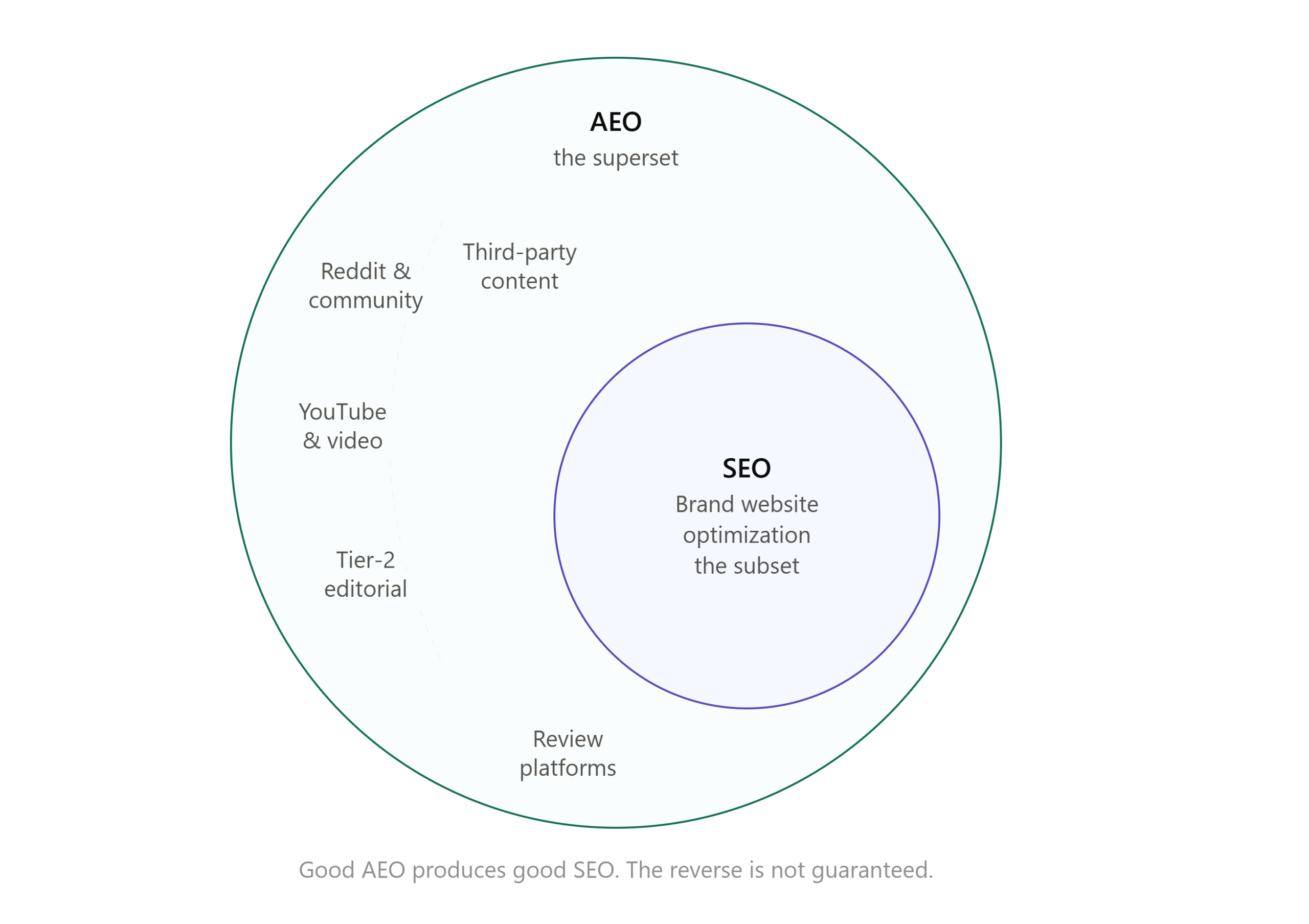
If you’re genuinely good at AEO, you’re probably doing competent SEO as a byproduct. The technical hygiene, the structured content, the authority signals transfer. That’s the 30% overlap. But the reverse is not true. An excellent SEO who has spent their career optimizing brand websites is covering roughly 30% of what AEO actually requires. The other 70% is territory SEO was never designed to operate in.
AEO isn’t one surface. It’s many:
- Brand website (where SEO has always lived)
- Reddit and community platforms
- YouTube and video
- Tier-two editorial and independent publications
- Review platforms (G2, Trustpilot, and category-specific equivalents)
- Third-party blog content and creator output
SEO has a domain: yourbrand.com. AEO has a domain: everywhere AI looks.
The 30% overlap isn’t a failure of SEO. It’s a scope problem. SEO was never designed to operate across these surfaces. It was designed to help one domain rank in one search engine. It does that well. It just doesn’t do the rest.
Why SEOs are struggling with AEO
This is the part I want to be honest about, because I don’t think it’s a skillset problem.
SEOs aren’t failing at AEO because they lack intelligence or rigor. They’re struggling because their professional frame excludes the surfaces where most AI citation share actually gets built. When you’ve spent your career focused on one domain and one search engine, that’s the lens you apply to every new problem. It’s not laziness. It’s the natural consequence of deep expertise in a narrow domain.
And through that lens, AEO looks 80 to 90 percent familiar. Because the slice of AEO that IS familiar maps cleanly onto everything they already know. The parts that are unfamiliar (building authentic community on Reddit, working with third-party creators on YouTube, placing editorial content on independent publications, managing brand sentiment across surfaces they don’t control) are simply outside the frame. Not wrong, just invisible.
Here’s a concrete example of what that blind spot costs.
A single negative article from a minor niche blog can introduce false negative sentiment into a brand’s AI-generated answers. The brand’s own site content is completely powerless to counteract it. No amount of schema markup, internal linking, or page optimization changes what an AI says about your brand when a third-party source is pulling the conversation in the other direction.
The only solution is building positive third-party content across other surfaces that shifts the overall consensus. That’s a pure AEO motion with no SEO equivalent. And brands optimizing only their own site are blind to it entirely, not because they’re doing the wrong things on their site, but because the problem isn’t on their site.
Brands doing only on-site optimization are doing the easy part and calling it done.
The reason it looks like 80% of the job is that 80% of the familiar work is there. The other 70% of the actual job is in territory SEO never had to develop.
What AEO actually forces you to do differently
AEO isn’t harder than SEO in technical complexity. It’s harder in organizational complexity.
SEO lived in one team. An SEO manager, a content writer, a technical developer. One workflow, one domain, one set of metrics.
AEO requires community managers who understand Reddit culture. Video strategists who know how YouTube content gets retrieved by AI systems. Editorial relationships with independent publishers who will actually cover your category. PR instincts for managing third-party sentiment across surfaces you don’t own or control. The ability to coordinate all of this into a coherent signal rather than a scattered effort.
That’s genuinely cross-functional work. Most SEO teams aren’t built for it. Most SEO agencies don’t offer it.
We use a framework at ScaleVisible called the three-legged stool: Reddit and user-generated community content, YouTube and video, and tier-two editorial. Three different disciplines. Three different production workflows. Three different relationship types. They compound when they work together. The brand website sits underneath all of this as the foundation, not the whole structure.
The foundation is not the building.
One other thing worth naming: even the measurement layer is different. The SEO toolkit has decades of standardized metrics. Everyone agrees what domain authority means, what a ranking position means, what organic traffic means.
The AI visibility measurement space doesn’t have that yet.
Tools like Profound and Peec.ai are genuinely useful, but the industry hasn’t reached the same level of standardized metric interpretation. You’re working with more ambiguity, more judgment calls, and more cross-surface correlation than SEO ever required. That’s not a knock on those tools. It’s just a real difference in how mature the disciplines are.
My Bottom Line: Good SEO is Table Stakes
If good SEO were truly good AEO, every top-ranked website would be dominating AI citation results.
They’re not. The correlation exists, but it’s weak. Because citation share is built across surfaces that ranking in Google has never touched, and the strategies that move those surfaces are not in the SEO playbook.
The SEOs saying “nothing to see here” aren’t wrong that their skills transfer. They’re wrong about how far they transfer.
AEO is the superset. SEO is one input into it. Calling SEO 80% of AEO is like saying a hammer is 80% of a construction crew because it’s the tool you know best.
The hammer is real. The work it does is real. It’s just not the whole job.
Ewen Finser is the Founder and CEO of ReddVisible and ScaleVisible, working with 120+ brands on AI visibility and Answer Engine Optimization.